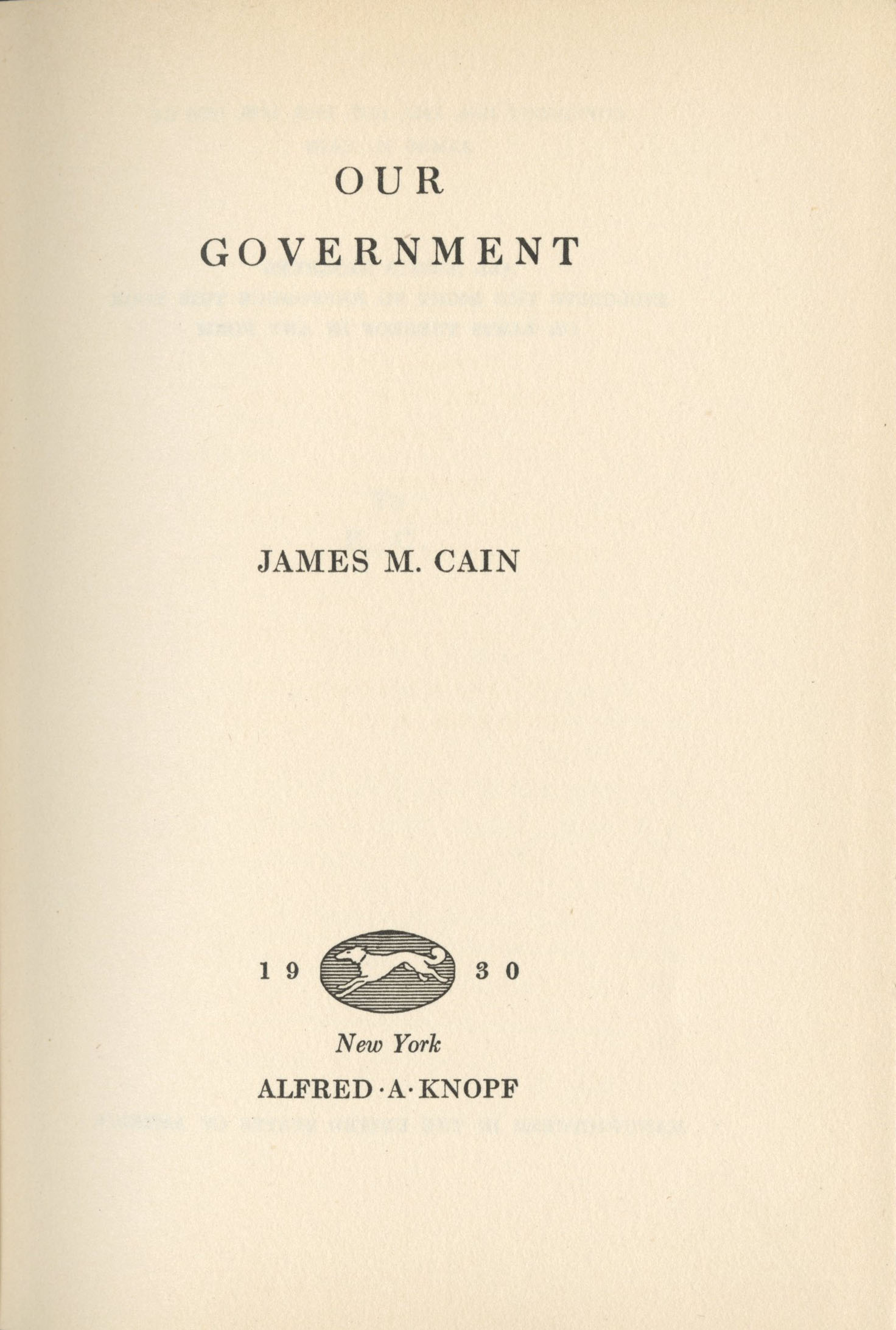
James M. Cain’s first novel, Our Government
From the very beginning of our nation’s birth 250 years ago, it has been the policy of many writers, illustrators, playwrights, and other creators to skewer the United States Government for whatever shenanigans the bureaucracy is up to.
In 1930, just ten years after white women were granted the privilege of voting in the United States, James M. Cain, a 1910 graduate of Washington College and the son of the former Washington College President, published the book Our Government.
Women's right to vote was of particular interest to the unnamed New York Times reviewer when the book came out “It is to be hoped these dialogues will encourage more women to cast their vote regularly, for whether they know it or not, it is all true— this play-acting and bunk that assume the toga of public office!” The same unnamed reviewer encouraged Cain to pursue a future foray into playwriting for his dramatic, over-the-top portrayals of politicians that were, “too much of a ‘wow' in character to be hidden between the pages of a book.” Shortly after the book's publication, Cain worked as a screenwriter in Hollywood and as a playwright. There's a letter in the College archives about a play Cain was working on, based on a fictional version of Chestertown, shortly before he died.
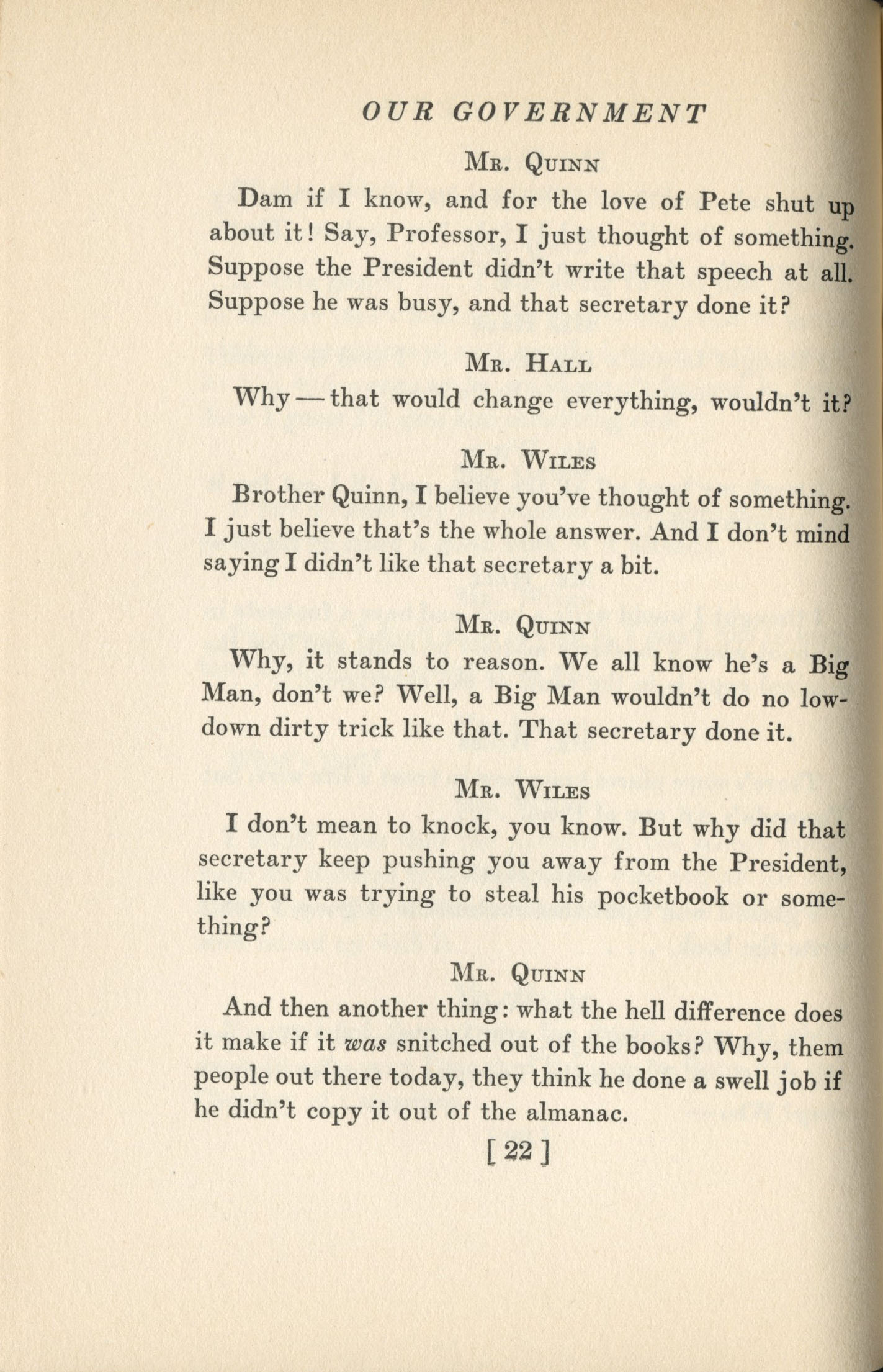 The first story in Our Government is a fictional account of four men from the Towanda Chamber of Commerce who have
convinced the President of the United States to visit their town and give a speech.
They are proud of the gathered crowd and of the scholarly speech given by the President.
However, one man, Mr. Hall, or “the professor,” notices a similarity between the speech
and an Encyclopedia. They conclude that the President has plagiarized the text. Later,
they convinced themselves that he didn't write it at all. It was his secretary, not
him; therefore, no harm was done.
The first story in Our Government is a fictional account of four men from the Towanda Chamber of Commerce who have
convinced the President of the United States to visit their town and give a speech.
They are proud of the gathered crowd and of the scholarly speech given by the President.
However, one man, Mr. Hall, or “the professor,” notices a similarity between the speech
and an Encyclopedia. They conclude that the President has plagiarized the text. Later,
they convinced themselves that he didn't write it at all. It was his secretary, not
him; therefore, no harm was done.
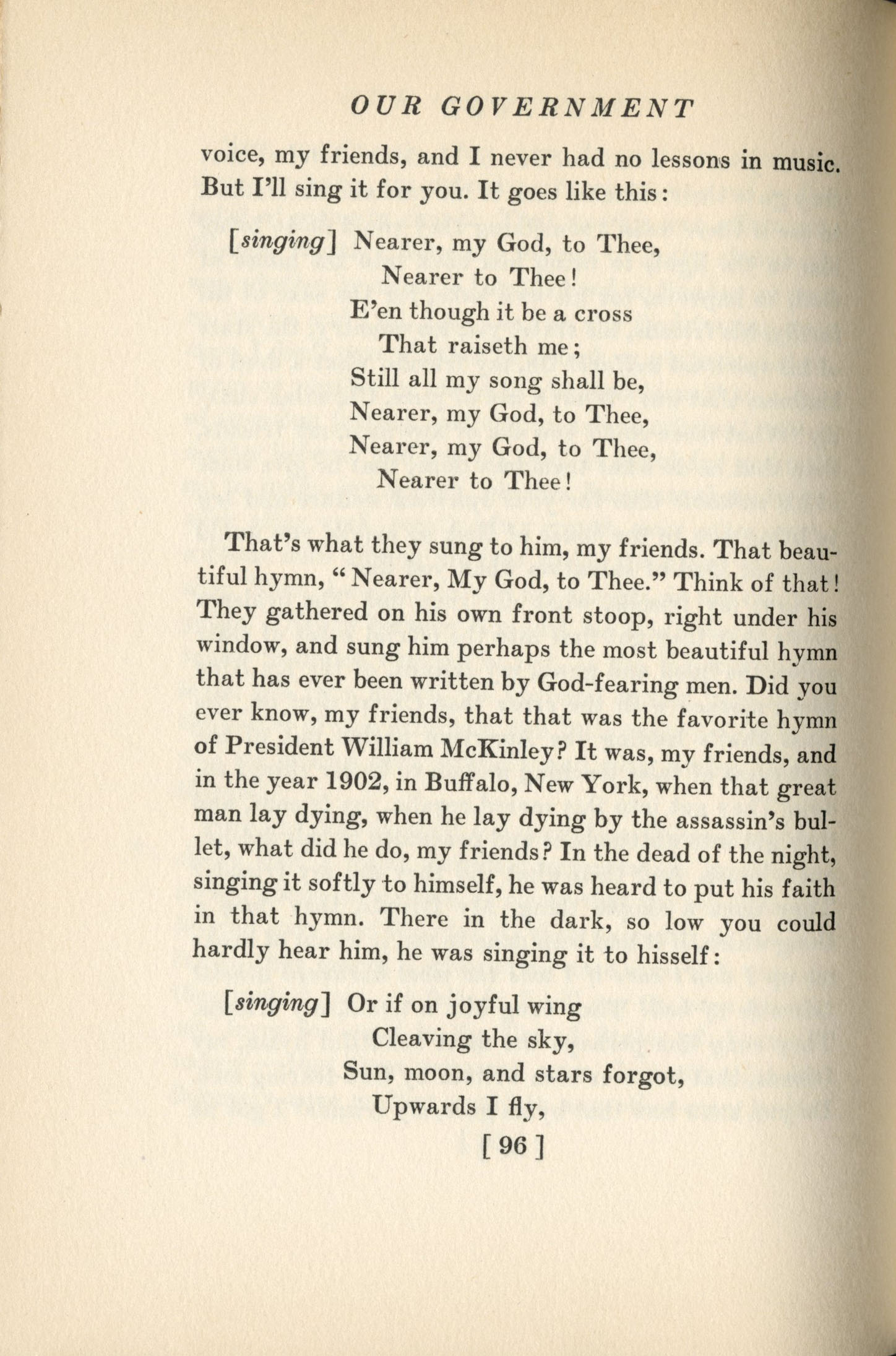
Each chapter of Our Government focuses on another level of the United States government, and each level is played upon for satirical effect. A chapter on Congress and its dangerous mix of religion (specifically Catholicism) and politics, follows the one on the president. A later chapter has a heavily accented State Governor who is asked to commute a ten-year sentence, but the Governor is so drunk and confused, he instead imprisons the man to life for a minor role in a coal mine protest. Further, another set of chapters focuses on a murder trial of a man who shot a member of the Ku Klux Klan as the KKK member sang a hymn on the man's front porch at three o'clock in the morning. Each chapter is from a different point of view: the prosecutor, the judge, and the jury, and each focuses on the defendant's lack of piety, rather than the threat of the Klan. Until, of course, one man is found to be a potential member, and then the jury is surely scared the Klan might find out what they have been saying.
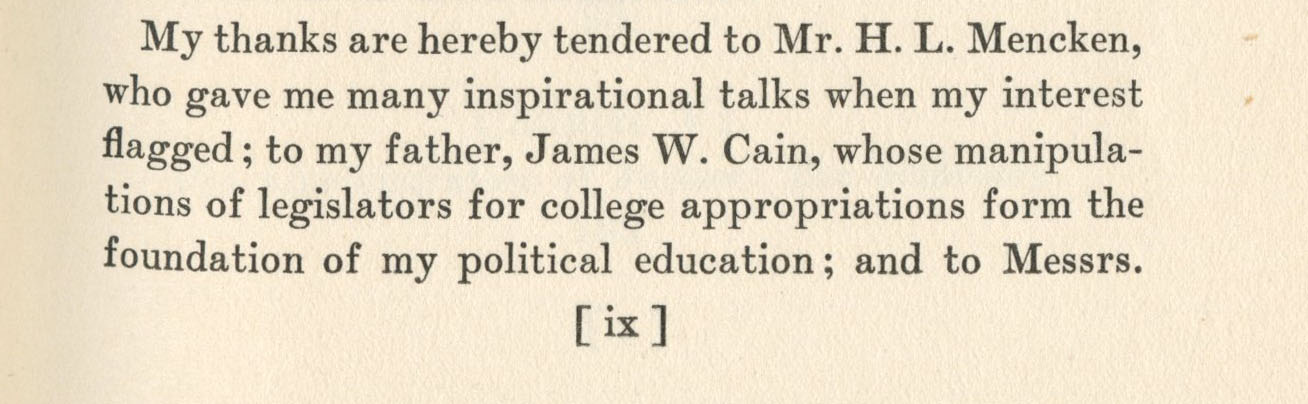
In the preface Cain said that:
the United States will be unique among nations. It will know not only what its government was intended to be, and what it ought to be, and what it might be if it were only better; it will know what its government actually is.
Cain lamented in the preface that he didn't dive into every aspect of our government, specifically taxes, of which he states:
the only function which all government has in common, and perhaps the chief reason for its existence.
However, he does state that many of the chapters are based on newspaper articles that he fictionalized for the various government entity points of view, and that the later sections on the military are based on his own personal experiences of that branch of government during World War I.
To read this and many other rare satirical and serious books on democracy, please make an appointment with the Archives and Special Collections: https://washcoll.co1.qualtrics.com/jfe/form/SV_9tx59lQEh2mcLkx
The electronic version of Our Government by James M. Cain is available through the Internet Archive here: https://archive.org/details/ourgovernmentits0000jame/page/n7/mode/2up