
Economic Analysis Positions Eastern Neck Wildlife Refuge as an Indispensable Engine for Kent County
Economics professor Brian Scott assists local advocates in making the case for continued federal funding and environmental stewardship.
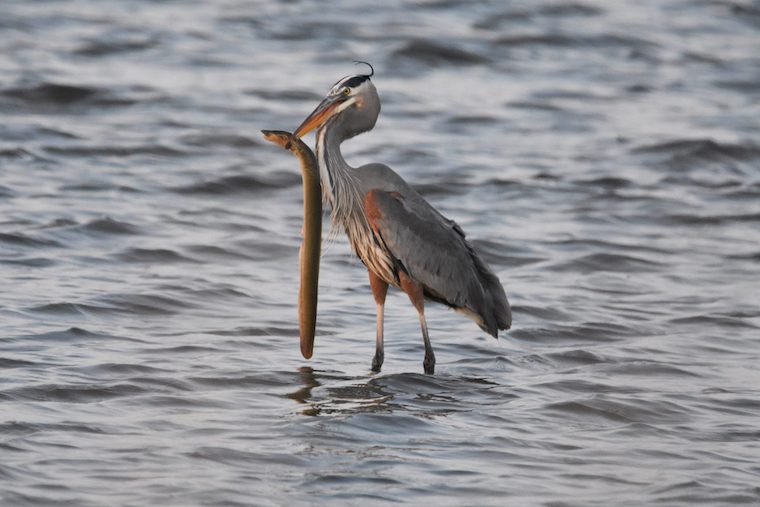
A Blue Heron stands in the waters near Eastern Neck Island. Photo courtesy of Friends of Eastern Neck.
In late March last year, the Friends of Eastern Neck (FOEN) found themselves grappling with the reality of declining federal budgets and staffing cuts. Just a few months prior, they had had to cut staffing at their Visitors Contact Station due to appropriations cuts at the federal level. As a non-profit dedicated to supporting the Eastern Neck National Wildlife Refuge (ENWR), their board realized they were in need of some hard data to prove to policymakers that the Refuge was more than just a sanctuary for migratory waterfowl—it was a vital economic engine for Kent County. With this need in mind, the board turned to Washington College's Brian Scott for help.
For Scott, the Jim Lim Professor of Environmental Studies and Economics and co-chair of the Economics Department, the decision to step into the role of neutral third-party analyst was an easy one.
 “As a faculty member I'm always delighted when my interest and research directly help
others make sense of the world around them,” Scott said, noting that his departments
remain committed to helping students and others understand their environment better.
“It's worth knowing the economic value a refuge brings to the local community, as
it helps policymakers allocate resources more efficiently. We always want to help
[everyone] make more informed personal decisions.”
“As a faculty member I'm always delighted when my interest and research directly help
others make sense of the world around them,” Scott said, noting that his departments
remain committed to helping students and others understand their environment better.
“It's worth knowing the economic value a refuge brings to the local community, as
it helps policymakers allocate resources more efficiently. We always want to help
[everyone] make more informed personal decisions.”
Volunteering his time and expertise, he began a month-long process of reconciling national reports with granular local data to quantify the "refuge effect" on the surrounding community.
The resulting analysis, 2025 Economic Impact Analysis, paints a picture of an indispensable regional asset. According to Scott's findings, the refuge injects an estimated $1 million or more annually into the local economy. For the nearby town of Rock Hall, the only gateway to the island, this infusion of capital is a lifeline. The report highlights that visitor spending sustains at least nine local jobs and contributes over $250,000 in employment income.
One of the most critical aspects of the study is the timing of these dollars. While Rock Hall's boating-oriented economy is highly seasonal, the refuge draws visitors year-round for bird watching, hiking, and hunting. This provides a consistent revenue stream during the off-season when other local industries are often dormant. Scott noted that even in the winter months, visitation numbers remain roughly half of their peak levels, ensuring that restaurants, fuel stations, and grocery stores in Rock Hall, as well as Chestertown, see continued traffic.
The impact of the study was immediate. The Friends of Eastern Neck Board of Directors shared the analysis with the mayor of Rock Hall, the Kent County Commission, and the Eastern Shore staff liaisons for Congressman Andy Harris and Senators Angela Alsobrooks and Chris Van Hollen.
In a letter to Washington's Provost Kiho Kim, the Board expressed their deep appreciation for the partnership. "We firmly believe that Dr. Scott's analysis will positively influence any future funding and staffing decisions for the refuge," the Board wrote. "We are deeply grateful for Dr. Scott's time and enthusiasm.”
For Scott, the project remains ongoing as he seeks more granular data to refine the results. However, his stance remains rooted in academic integrity.
"From the start I told FOEN that I will report whatever I find, even if it is not what they were expecting or hoping for," he said. "My goal is to have an unbiased analysis of the benefits of the reserve which policy makers can use in their decision-making process.”
By applying rigorous economic modeling to local conservation, Scott has provided a lower bound on the refuge's value, noting that his report doesn't even begin to capture the heritage of the land or its role in water filtration and storm mitigation.
Scott's work and dedication to the regional community aligns directly with Washington College's mission of civic leadership, which emphasizes preparing students—and faculty—to serve as responsible citizens who are deeply engaged with the environmental and social challenges of the Chesapeake Bay region.
"The work Dr. Scott has done for the Eastern Neck National Wildlife Refuge perfectly captures the essence of civic engagement and leadership at Washington College," said Provost Kiho Kim. "It shows how our faculty leverage their knowledge to address complex social and environmental issues right in our own backyard in service of the broader public. Brian's dedication to maintaining a rigorous, data-driven perspective ensures that local advocates and policymakers have the credible information they need to make informed decisions for the benefit of all."
- Dominique Ellis Falcon