
Truth in Unsettling Times: John Harwood on the Challenges of Deepfakes, Consolidation, and Rhetoric in Modern Journalism
During a multi-day visit to Washington College, the Emmy-nominated journalist emphasized the need for versatility and critical thinking while honoring his father’s legacy with a new journalism scholarship.
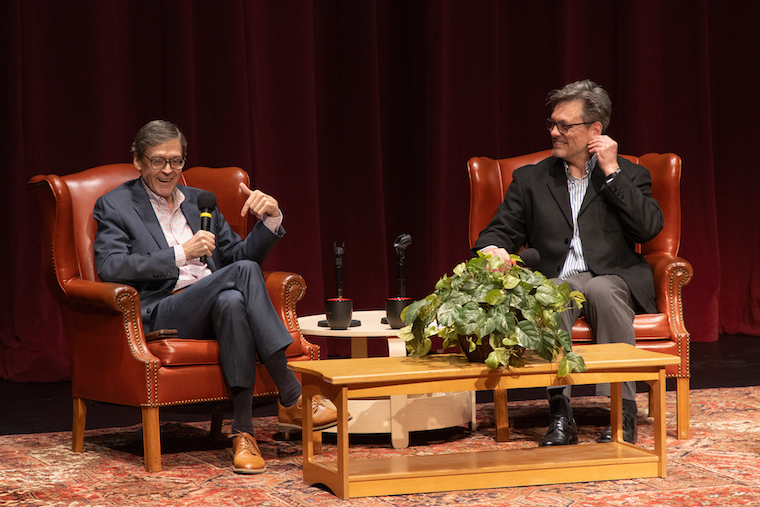
Reporter John Harwood (left) and Roy Kesey, Associate Director of the Washington College Rose O'Neill Literary House, (right) talk at the Richard L. Harwood Lecture in American Journalism.
In a time defined by deep political divisions and a shifting media landscape, veteran correspondent John J. Harwood returned to Washington College last week to deliver a message as clear as it was cautionary. Speaking to an audience of over 160 students, faculty, staff, and local community members—with another 100 viewers joining via livestream—Harwood delivered the annual Richard L. Harwood Lecture in American Journalism.
John Harwood's impressive journalism career spans three decades. He has served as Chief Washington Correspondent for CNBC and reported for CNN, The New York Times, and The Wall Street Journal, as well as offered political analysis to NBC, MSNBC, NPR, and PBS. He has interviewed every U.S. President from George H.W. Bush to Joe Biden and was part of the Journal's Pulitzer Prize-winning team covering the 9/11 attacks.
This was his first time giving the Richard L. Harwood Lecture in American Journalism, which is named for his father, a distinguished journalist and editor whose 50-year career in reporting included three decades at the Washington Post. Named to the Hall of Fame of the Society of Professional Journalists in 1997, Richard Harwood was also a trustee, journalism advisor, and adjunct professor at Washington College. The series has previously hosted distinguished voices such as Susan Goldberg, Rachel Kaadzi Ghansah, Karl Rove, and Cokie Roberts.
“It's an honor to have John Harwood back at Washington College to visit classes, talk with student journalists, and to discuss the importance of truth in deeply unsettling, divided times,” James Allen Hall, director of the Rose O'Neill Literary House, noted prior to Harwood's visit. “His experience moderating debates and town halls gives him a unique perspective on the role of the journalist in shaping public affairs. It is a great delight to give our students the chance to learn from such a dedicated journalist and public servant.”
During his discussion with Roy Kesey, associate director of the Rose O'Neill Literary House, Harwood noted that the stable industry Harwood and his father once navigated has been replaced by a digital revolution that has fragmented audiences, which threatens the financial viability of publications and outlets. The changing nature of journalism in the last 10 years was top of mind for Harwood.
“Covering politics and government used to be about being present at an event—if you were covering Congress, you're on the Hill; if you're covering the White House, you're there or on the telephone; you're on campaigns traveling with candidates. One of the things that has changed in political reporting in the course of my career is that now, because of radio and tv, people know the outcome of that event instantly,” Harwood said. "So you're not telling them what happened, now you're telling them what that means. [As a journalist] you're trying to provide context, meaning, and analysis. The imperative to do that increases as you get older in your career."
Offering up an example of how the changes in maintaining that role of analyst led to his being let go from CNN, Harwood spoke about the changing nature of big media outlets and how they cover issues.
“Part of what CNN did to appease Trump was to do less analysis,” he said. “I was asked if while I was there whether I felt pressure to say things differently—the answer is no. At that point in my career, the value that I had was to put it in context based on things I'd seen before. That's what I do. If I can't do that, there's no point in me having the job.”
But, eventually, the job changed. Outside influences on how the network chose to cover the news of the day eventually took hold.
"Making a profit [as an outlet] has become much more difficult," Harwood observed, pointing to deep staff cuts announced last week to The Washington Post. He also spoke on the growing influence of wealthy owners of media companies who may be tempted to prioritize business interests over newsroom integrity. For Harwood, the challenge is not just in finding the truth, but in a public that is increasingly resistant to accepting it—a situation he described as "the worst I could have ever imagined."
He described the current political climate as a "real test of the country," where leaders "repeat over and over again things they know aren't true." Now operating as an independent journalist via Substack, Harwood highlighted how new platforms allow reporters to reach millions without corporate oversight, even as he lamented the shrinking reach of traditional major outlets.
Kesey said he found Harwood's perspective on his work valuable and thought it provided some important things for audience members to reflect on.
“It was great to get a chance to hear John think out loud about stories he's covered, and about the state of journalism generally,” said Kesey. “I hope the audience walked away with a clearer sense of the challenges faced by political journalists these days, including AI deepfakes, oligarch ownership, and state-sponsored intimidation and violence."
In addition to the examination of industry-wide problems, Harwood's discussion served not only as a masterclass in political reporting but as the formal stage for a major institutional announcement: the launch of the Richard L. Harwood Scholarship. The new four-year renewable scholarship will award $1,000 to an incoming student who demonstrates exceptional talent in the craft of journalistic writing or nonfiction writing about public affairs. The scholarship aims to support the next generation of truth-seekers. Recipients are encouraged to engage with the College's journalism programs and student-led publications like The Elm.
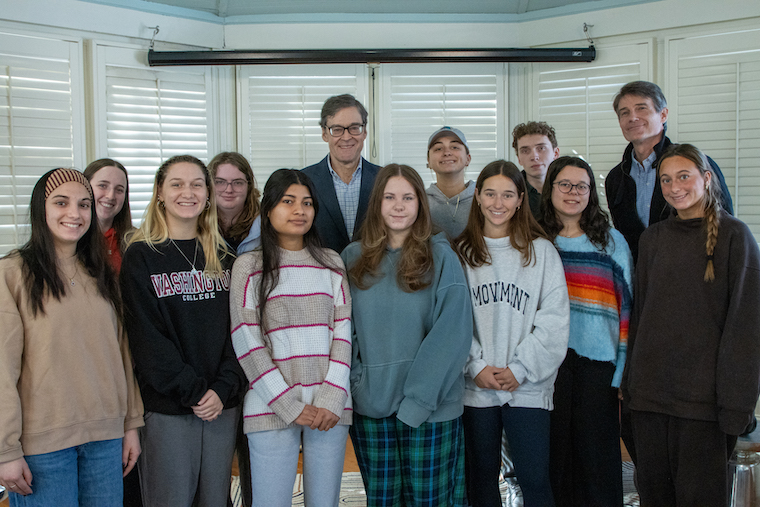
John Harwood (center in back) and English Professor Sean Meehan, (far right in back) join Washington College students for the Art of Rhetoric class following his appearance at the Richard L. Harwood Lecture in American Journalism .
When asked what advice he'd give to budding journalists, Harwood recounted his time spent counseling seniors at Duke University.
“They would say they wanted to work at The New York Times right out of college. And to that I emphasize versatility—be able to write, talk to people, operate a camera, and take pictures and video. Increasingly at more outlets, you're asked to do more things. So being prepared in a way that allows you to move in different directions,” he advised. “I would say bless you to those who want to go into [the field]. It gives me hope that there are those who still want to, given the dire nature of our business.”
The conversation continued the following day when Harwood visited English Professor Sean Meehan's “Art of Rhetoric” class. He spoke with students about the erosion of decorum in public life, noting that cable news has devolved into something "shout-ier and angrier." He pointed to the use of "bad faith arguments"—such as claims of stolen elections or inflammatory lies about immigrants—as tools deployed for specific political purposes.
When asked about the impact of artificial intelligence, Harwood acknowledged its power as a tool for efficiency but expressed concern over its potential to fuel deepfakes and discourage the critical thinking essential to journalism.
"The goal of a modern economy is to move up the value chain by doing things that require more advanced thinking," he noted, warning that a reliance on AI could reduce the level of education for future journalists.
For students like Evelyn Lucado '26, who engaged Harwood during the lecture's Q&A session, the experience was a rare opportunity to bridge the gap between classroom theory and industry reality.
"The world of journalism and mass media is changing rapidly, and it was really interesting to see the perspective of someone who's been in the industry for so long," Lucado said.
As Harwood concluded his visit, he offered a hopeful charge to those entering the field, emphasizing that despite the challenges facing the business, the dedication to telling the truth and providing the public with smart context remain paramount for a healthy and informed society.
- Dominique Ellis Falcon