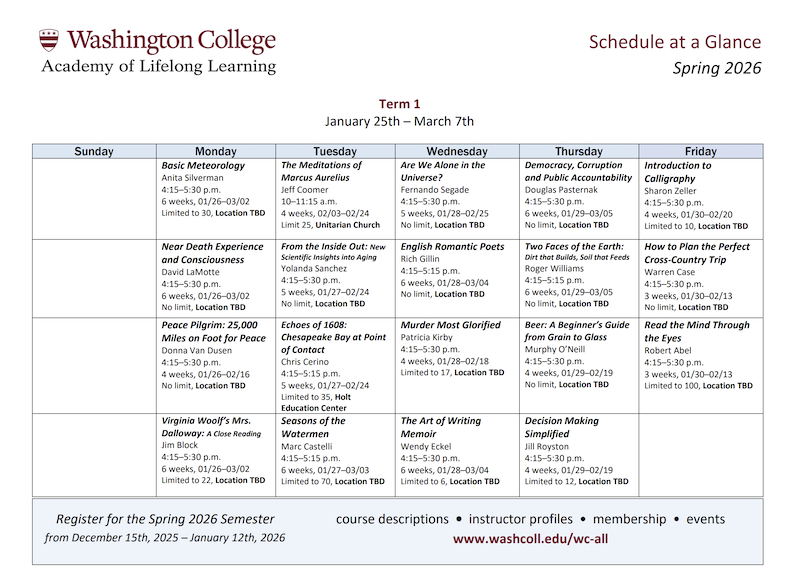
Term 1 Courses
Term 1:
Sunday, January 25 - Saturday, March 7
Monday Classes
Math, Science, and Technology
Anita Silverman
6 classes
4:15 pm-5:30pm
This course is limited to 30 students.
This course will enhance your understanding of the basic weather elements of wind, moisture, pressure, temperature, and precipitation. Different sources of forecasts online and in the media will be explored and interpreted. Weather hazards and safety will be discussed. Satellite, radar, and other methods of observation will be presented, as well as how you can participate as a citizen-scientist.
ANITA SILVERMAN recently retired from the National Weather Service after a 37-year career as a meteorologist. Her passion for weather started at an early age. She attended Penn State University then joined the National Weather Service in 1987. Her career took her to offices in Maryland, Missouri, and Virginia. Anita enjoys all four seasons and has even been on a storm-chasing trip through the Plains.
Humanities
David LaMotte
6 classes
4:15pm-5:30pm
The Near-Death Experience phenomenon has been with us thousands of years. The term was coined by psychiatrist Raymond Moody in his Life After Life book in 1975, and most of us by now are familiar with the term and some of the stories. What the research of the last 50 years into this phenomenon now tells us about life and death, consciousness and the brain, and reality itself, should shift our view of each other, of much that we have been taught, of our scientific models, and perhaps of our religious beliefs. How do these findings help us deal with our own mortality, approaching end of life and the death of loved ones? How do these strikingly consistent experiences inform us about the very purpose and value of life? The instructor will present videos of near-death experiencers telling their stories, summarize consistent features and discuss their implications. Nothing is more powerful than first-hand experiencer descriptions. These will be reviewed in light of now considerable research of thousands of accounts. New brain-mind models now being more embraced will be presented. Because of new research in NDEs and similar phenomenon, materialist scientific models may not be longer sufficient. The course will explore how quantum physics seems to support the reality of these experiences.
DAVID LAMOTTE is the retired president of the LaMotte Chemical Products Company and has been interested in near-death experiences, the research, and the implications for mankind since first attending a conference on the subject in 2003 with his father (same name, Episcopal Priest) who taught courses on this subject for WC ALL for several years in the early 2000's. David leads a local NDE study group that has been meeting monthly since 2006.
Humanities
Donna Van Dusen
4 classes
4:15pm-5:30pm
In 1953 at the age of 51, with no money and all her earthly possessions stowed in the pockets of her tunic, Peace Pilgrim began her 25,000-mile walk to spread the message of peace. She walked alone as a chance to inspire others to work for world peace and to find peace in themselves. Having reached her 25,000-mile goal in 1964, she continued her walk, having vowed to “…remain a wanderer until mankind has learned the way of peace, walking until I am given shelter and fasting until I am given food.” She spoke with thousands of people during the McCarthy era, the Korean war, the Vietnam era and beyond, until her untimely death. This course provides a moving account of a woman who experienced a calling and then followed that calling in a unique way and by sharing a deeply inspiring message. Additionally, the course involves discussions based on her message on topics that continue to confront us today as well as those that can inspire inner peace.
DONNA VAN DUSEN, Professor Emerita at Regis University in Denver Colorado, has found that retirement has brought opportunities to further explore numerous areas of interest. Her interest in creating meaning in later life, women's life stories, conflict resolution, and persuasive communication came together when, by chance, she stumbled upon an article that mentioned Peace Pilgrim. Intrigued and inspired by Peace Pilgrim's story and message, she hopes to share that story with others.
Humanities
Jim Block
6 classes
4:15pm-5:30pm
This course is limited to 22 students.
Woolf writes in one of her essays that “in or about December 1910, human character changed.” The change came about because human relations had changed and that, in turn, changed literature. Mrs Dalloway is a compelling example of the change from 19th traditional to early 20th century modern literary technique. In this novel, we move through a single day in the life of Clarissa Dalloway as she prepares to give a party in post-Great War London. We also follow Septimus Warren Smith, a shell-shocked veteran with the imagination of a poet and without enough mental and psychological strength to hold himself together. Woolf's stream-of-consciousness narration subtly shifts from one character or scene to another, demanding a reader's close attention. In the long run, we are persuaded that everyone is connected to everyone else, even a well-off upper-class lady and a poor, suffering, working-class Great War veteran. Woolf's prose is magnificent and elegant, sometimes making her readers require a seat belt for their reading chairs. In lecture-free class meetings, we will read (often aloud) key passages and then examine them in detail, often looking at the prose as if it were verse. Participants will receive some background material and a first reading assignment before the course begins.
Required text: Mrs Dalloway, The Virginia Woolf Library Annotated Edition With an introduction by Bonnie Kime Scott, Harcourt Harvest, 2005. ISBN 978-0156030359. We must all have the same page numbers for discussions. The new, annotated edition will not do for first-time readers.
JIM BLOCK studied English literature at the University of Virginia, went to sea for two years on an aircraft carrier in the Pacific, and then took an M.A. in English at the University of Iowa. He then taught English, coached, advised, talked with, and lived with teenagers at Northfield Mount Hermon for 43 years. He spent a year teaching at Marlborough College, Wiltshire, and another at Robert College in Istanbul.
Tuesday Classes
Humanities, Environment
Chris Cerino
5 classes
4:15pm-5:30pm
Holt Education Center, 200 S Cross Street, Chestertown, MD 21620
This course is limited to 35 students.
This course uses the 1608 voyages of Captain John Smith and the incredible accounts of the flora, fauna, and Native American cultures he encountered to introduce participants to a Chesapeake that few today can even imagine: a balanced ecosystem inhabited by passenger pigeons, wolves, bear, twelve-foot-long sturgeon, massive schools of spawning shad, herring, and striped bass, and old growth forests spreading out in all directions. Importantly, the seminar focuses heavily on the fascinating indigenous cultures that called the Chesapeake home for hundreds of generations prior to the arrival of Europeans, introducing students to the tools, trade goods, political systems, arts, and armaments utilized by Native people. Topics that will be covered during this five-week course include: The 1608 voyages of exploration of Captain John Smith; Captain John Smith's 1612 map of the Chesapeake Bay; The 1585 watercolor paintings of John White; The Indigenous Tribes of the Chesapeake Region; Native American artifacts: stone tools, pelts, trade goods, etc.; The Chesapeake Bay Ecosystem: 400 Years Ago and Today. Content will be presented in a variety of ways, including digital projection systems, lectures, and lots of hands-on interactions with historic and reproduction artifacts from the 17th century
CHRIS CERINO has been teaching students of all ages about the Chesapeake Bay's history, ecology, and culture for the past thirty years. In addition to his extensive knowledge of the estuary's fisheries, Mr. Cerino is also an avid collector of Native American artifacts with a personal collection of over 2,000 pieces. He was instrumental in organizing Sultana Education Foundation's 2,500-mile reenactment of Captain John Smith's 1608 expedition on the Chesapeake Bay, which brought the story of the 17th century Chesapeake to hundreds of thousands of local residents during the summer of 2007.
Math, Science, and Technology
Yolanda Sanchez
5 classes
4:15pm-5:30pm
Our scientific understanding of aging has undergone a major transformation in the last two decades. Aging is no longer viewed simply as the inevitable wearing out of the body, but as a process driven by specific biological mechanisms. Scientists now refer to these processes as the Hallmarks of Aging, a modern framework to understand aging. These hallmarks include molecular and cellular changes such as senescence (when cells do not die properly, triggering inflammaging), mitochondrial dysfunction (resulting in reduced energy production), epigenetic alterations (DNA modifications leading to altered gene activity patterns) and more... Most of this terminology is now part of current conversations about aging! This course will highlight new research that illuminates the body's internal aging programs and how changes in our cells' ability to divide, generate energy, and respond to stress contribute to aging features, from wrinkles to cognitive decline. We will also discuss if this scientific framework can be used to develop new therapies to manage chronic diseases associated with aging. Each session will translate scientific findings into clear insights, so no background in science is needed to enjoy this exploration of the molecular underpinnings of one of life's most universal experiences, aging.
YOLANDA SANCHEZ PhD is a scientist with 35+ years of combined academic and industry experience in translational research and drug discovery and development, currently working as a consultant for pharma and biotech. She is fascinated by scientific advances in hallmarks of aging and by the potential to develop new drugs to treat chronic diseases associated with aging. She has lived in Chestertown since 2022 and loves spending time on the Chesapeake Bay waters.
Fine and Performing Arts and Crafts
Marc Castelli
6 classes
4:15pm-5:15pm
This course is limited to 70 students.
This course will illustrate the seasons of the watermen through digital photographs. These seasons are not defined by the calendar but by their harvests as they work through the year. These include the commercial harvesting of crabs, different fish, eels, and oysters. The discussion will cover culture, politics, regulations, and traditions. Along with the photographs, the instructor will tell many stories from his 35 years of working alongside the watermen. He prefers to use his photographs instead of paintings because using his art always distracts from the more important story. This will not be a how-to-paint with watercolors class, and there is no need for any texts or other materials.
MARC CASTELLI has painted watercolors of the Chesapeake Bay watermen, their boats, and tools for over 35 years. He is fascinated by the subject and the conditions in which they work, their traditions and history. He tries to understand the byzantine labyrinth of regulations and laws under which they work while earning a living from harvesting the seafood of the Chesapeake and its tributaries. Working alongside them gets him closer to a hands-on knowledge of the work. It is from his photographs that he derives his watercolors, and pen and ink drawings. His work appeared in the Emmy award winning documentary, "Waters Edge; The Black Watermen of the Chesapeake", by Alexis Aggrey for MPT.
Humanities
Jeff Coomer
4 classes
Starting on 2nd week
10 -11:15 am
Unitarian Church
This course is limited to 25 students.
Nearly two thousand years ago, the most powerful leader in the Western world sat in his quarters on a remote border of his empire and recorded a series of personal reflections to help him stay true to his principles for living a virtuous life. Untitled and not intended for publication, those reflections by Roman Emperor Marcus Aurelius have endured to the present day as one of the most popular and approachable works in all of philosophy, and Stoic philosophy in particular. Much of their appeal lies in their practical orientation focusing on what is truly important and within your control, resisting the temptation to make quick, emotional judgments, and showing grace and compassion in your interactions with others. As a collection of short, unconnected observations without an overall organizational structure, Marcus' Meditations are best appreciated as part of a daily contemplative practice, much as how they were written. For this course, however, we will consider the text in four parts, with discussion focused on the principles that emerge from the individual entries and how we can apply those principles to meeting the challenges in our own lives. Any of the many translations of Meditations available for purchase online or at traditional booksellers should be suitable for this course. For those who do not already have access to a copy, I recommend the 2002 translation by Gregory Hays (Meditations, ISBN 0812968255), which includes an excellent introductory essay.
JEFF COOMER is a Washington College graduate and the retired CIO of a multi-billion-dollar division of a Fortune 250 company. A long-time student and practitioner of Buddhist and Stoic philosophy, he has taught numerous WC-ALL courses on those and other topics, and led occasional Socrates Café conversations exploring philosophical issues.
Wednesday Classes
Math, Science, and Technology
Fernando Segade
5 classes
4:15pm-5:30pm
Humans have been fascinated by the possibility of life outside Earth since ancient times. Finding extraterrestrial life would be the greatest scientific discovery of all time. But how likely is it that there is life out there, that we are not alone in the Universe? After all, space is a very big place; and it has existed for a long, long time. Stars are plentiful. We have found more than 6,000 planets around other suns. Planets are abundant, perhaps trillions of them in our Galaxy alone. Life should be present in many of them, shouldn't it? A new branch of science, Astrobiology, combines our knowledge of the history of the Universe, how stars are born and die, how elements combine to form molecules, how life evolved on Earth, how life needs to keep evolving, and how civilizations arise and collapse. In this course, using a purely scientific approach, we are going to estimate how many living planets could be found in the Galaxy and how likely it is that in some of them there are other civilizations to communicate with. I will try to answer the question posed by Enrico Fermi: “since stars and planets are so abundant, where are the aliens”? Is there a “Great Filter”, a barrier so powerful that prevents life from expanding outward from home planets? For Earth, is such a “Great Filter” already behind us (i.e., we are destined for the stars) or looming ahead (i.e., it will extinguish our hopes)? Perhaps finding life in the Universe only depends on what we meant by “we” when we ask, “Are we alone?”. This course is not about UFOs, it is about science. In five lectures, I will provide some surprising answers and perhaps even some more surprising questions on this topic
FERNANDO SEGADE PhD, is a semi-retired molecular biologist and adjunct instructor in Biology at Washington College with a long-running interest in genetics, evolution, boats, birds, space, and life beyond Earth.
Humanities
Richard Gillin
6 classes
4:15pm-5:15pm
During the course we will read and discuss major works of the six great Romantic Poets: William Blake, William Wordsworth, Samuel Taylor Coleridge, Lord Byron, Percy Bysshe Shelley, and John Keats. The aim of this course is to read representative poems carefully with attention to relevant biographical and cultural elements, and to discuss the poems at length in class. The focus will be on one poet each week.
RICHARD GILLIN retired from the faculty at Washington College in December 2019 after forty-six years. He returned to the faculty on a limited basis in 2021. He has taught numerous courses in English Romanticism, 18th Century Literature, Satire, Post Colonial English Literature, Irish Film, and Victorian Literature. With his wife, Barbara, they developed and led the Kiplin Hall Program in North Yorkshire (England) and in West Cork (Ireland) for twenty summers. Richard has previously taught two courses in the WC All Program.
Social Sciences
Patricia Kirby
4 classes
4:15pm-5:30pm
This course is limited to 17 students.
America's fascination with murder seems insatiable. True crime stories continue to captivate millions of people, as television networks, podcasts, and YouTube channels devote hours upon hours to the topic. I wonder, is it the motivation behind the murderous act, or is it the murderer himself that captures our attention and draws us in? And why are some cold-blooded murderers embraced and glorified as "rogue heroes and bad boys?" Is it their physical appearance, social background, or the way the media presents them that leads us to overlook the viciousness of their acts and find them attractive and engaging? The course will probe these questions in an attempt to understand how and why certain murderers achieve the status and adulation of a 'rock star.' There will be four sessions, featuring both videos and lectures. The class size remains small to encourage in-depth discussions about this phenomenon and the men who personify it.
PATRICIA KIRBY holds a Ph.D. from American University. Her career included working in Baltimore City, first as a parole and probation agent, then as a police officer, and as a homicide detective. She entered the FBI as a special agent and was promoted to FBI profiler. Before retirement, she was an associate professor at Notre Dame of Maryland University, teaching courses in social deviance and forensic psychology.
Fine and Performing Arts and Crafts
Wendy Sand Eckel
6 classes
4:15pm-5:30pm
This course is limited to 6 students.
In this class, Wendy Sand Eckel will take you inside the makings of her award-winning Rosalie Hart Cozy Mystery Series, which began with a brief brush with the law that led her to study criminology. She will also talk about how her daughter's dyslexia eventually nudged her to move from a career as a psychotherapist to becoming a writer. Next, she will focus on the internal and external challenges she encountered on the road to publication, including how agents and editors work, the art of embracing feedback, and most importantly, how learning to listen is just as, if not more, vital than learning to write. From there she will delve into the creative process, how to fight creativity blocks, and how being disciplined sometimes works, but often doesn't. She will also focus on the process of finding and embracing your muse. In addition, she will be sure to save time for her favorite topic, her passion for cooking and how she weaves it into her mystery series.
The last fifteen minutes of the class will be open for participants to share their writing/creative challenges, and receive suggestions on how to overcome them.
WENDY SAND ECKEL is a trained life coach and published author of the Rosalie Hart Mystery Series. She also pens the advice column for the Maryland Writers' Association and loves to mentor aspiring authors. She encourages questions and comments and enjoys a good discussion about writing and creativity.
Thursday Classes
Math, Science, and Technology; Food & Beverage
Murphy O'Neill
In person; lecture/discussion
4 classes
4:15pm-5:30pm
This introductory course explores the cultural, historical, and technical foundations of beer. Students will learn how beer developed across civilizations, how ingredients influence flavor, how breweries operate, and how beer is made from start to finish. The course will draw from the instructor's professional brewing experience, including Snake River Brewing in Jackson Hole, Wyoming and founding a brewery in Santa Marta, Colombia. No prior brewing experience is required; beginners are welcome.
MURPHY O'NEILL moved to Chestertown almost 4 years from South America, where he was founder and partner in one of the largest craft breweries in Colombia. He first learned to brew beer at Snake River Brewing in Jackson Hole, Wyoming then went on to design a brewery from scratch in Santa Marta, a colonial city on the Caribbean Coast. His passion for designing flavors remains and he has helped Bad Alfred's Brewing and Distilling with some brewing operations and recipe development.
Political/Oversight/History
Douglas Pasternak
6 classes
4:15pm-5:30pm
Holding public officials and private corporate executives accountable to the public is a core tenet of all democracies. Today public accountability issues are front and center in our daily lives, on the news, in social media posts, and in political debates. Ultimately public accountability has a tremendous impact on all of us. Public accountability takes various forms. Congress has a unique oversight role with its investigative authority embedded in the U.S. Constitution. Inspector Generals (IGs) investigate waste, fraud & abuse within federal agencies identifying billions of dollars in wasteful spending and mismanagement each year, and the investigative media has a critical role investigating the U.S. Congress and the Executive Branch. Historic cases of public oversight will be examined throughout the course, and the instructor's own personal experience as a former investigative reporter and senior congressional investigator will be utilized to provide first-hand accounts of how public accountability works – and sometimes does not. Key themes discussed will include how federal officials and corporate executives are held accountable to the public; how investigators decide what to investigate; how they identify and cultivate sources and protect whistleblowers; how politics can adversely impact oversight; what tools and tactics investigators use to expose wrongdoing; and why the public should care deeply about public accountability. This course will be educational, at times enraging, and entertaining.
DOUGLAS PASTERNAK is a former two-time Emmy Award winning investigative reporter at U.S. News & World Report magazine and NBC Nightly News. He also led investigative teams on three oversight committees in Congress at the House Committee on Science, Space & Technology, the House Committee on Transportation & Infrastructure, and the U.S. Senate's Permanent Subcommittee on Investigations, part of the Committee on Homeland Security & Governmental Affairs. Doug wrote numerous cover stories at U.S. News, produced award winning hidden camera newscasts at NBC Nightly News, and has led scores of high-profile congressional investigations and hearings. He has also provided frequent talks to university students, congressional staff, and members of the federal Inspector General community about the role of public accountability in our society.
Social Sciences
Jill Royston
4 classes
4:15pm-5:30pm
This course is limited to 12 students.
Decision made? I don't know. Whether it's deciding what's for dinner or if it's time to sell a home, decision making can be frustrating and leave us feeling overwhelmed. “Decision Making, Simplified” is an engaging course learning the simple and repeatable INSIGHT framework. This approach was created to help you use your heart, head, and the facts to make decisions based on what matters most to you. Let's cut through the overwhelm, minimize the frustration, and try something new. How fun will it be to finally break the endless refrain of “I don't know, what do you want for dinner?”
JILL ROYSTON has over 20 years of experience helping people and organizations grow, as an executive coach, strategic advisor, and a former Chief Operating Officer. Jill created the INSIGHT framework to teach people how to make decisions with confidence using their heart, head, and the facts. Working with Jill, people break free from what they “should” do and instead create the life experiences that matter most to them, one decision at a time.
Environment
Roger Williams
6 classes
4:15pm-5:30pm
It is easy to overlook what we walk on every day, but dirt and soil hold the secrets of human civilization and survival. From the mud that built our earliest homes to the living soil that sustains our food, this course digs deep into humanity's most fundamental material, the ground beneath us. Humans have molded dirt into homes, roads, and waterways, often altering landscapes on a massive scale. In its first half, this course will explore the human uses/misuses of “dirt”, as a building material (bricks, adobe, carved caves, terracing), and as a landscape and waterway altering material (roads, dams, dikes, polders, canals, levees, trenches). Soil is the vibrant, living skin of the Earth, teeming with unseen life that makes agriculture, and our existence, possible. The second half of the course will explore “soil” as it pertains to its structure and composition, as well as the microbial, plant and fungal life it can sustain, and ultimately, the benefits of proper management, including our ability to feed ourselves. In both cases, we will look at the way humans have studied and define both these views of what is beneath our feet, and together, we will uncover how “dirt” builds our world, while “soil” keeps it alive.
ROGER WILLIAMS is an engineer by training (MEng), a beekeeper as avocation, and has a deep interest in soil as it pertains to the nutrients both we and the bees get from the plants. This interest has been with him for over twenty years, over which time he has done a lot of digging, both in soil and in literature. Roger is the Vice Chair of the Board of the Maryland Pesticide Education Network, and as such he has even more reasons to follow agricultural practices as they pertain to soil health.
Friday Classes
Travel
Warren Case
3 classes
4:15pm-5:30pm
The U.S. has so much to offer the road traveler: its scenic beauty, historic sites, major cities, outdoor activities, wildlife, special events, and so much more. The instructor believes that every American should (at least once in their life) start on one coast and drive to the other – it is the only way to truly appreciate the breath and variety of our country and its people. But how do you develop a trip plan that is affordable, practical, and fulfilling? This is a large country with so many possibilities that planning a cross-country road trip can be daunting. Sadly, many people put it off until retirement, but then never take it due to all the seemingly complex factors involved. But it doesn't have to be that hard. This course introduces potential destinations (especially the National Parks); identifies discusses scenic routes and special events; discusses lodging options; determines the pace of long-distance drives; develops a realistic budget; and perhaps most important, ties the list of proposed destinations together into one comprehensive trip plan that is both do-able and flexible. Then . . . you will be ready to hit the road!
WARREN CASE fell in love with travel in general and road trips in particular at a young age due to the family drives. Although a native of the Washington D.C. area, he attended college in southern California which provided numerous opportunities to cross the U.S. on the road. He began arranging group trips for family and friends. By the time he was 20, he had visited all the “lower 48” states and has since crisscrossed the country 20+ times. When possible, he takes divergent routes to stop at new destinations along the way. He takes pleasure in introducing others to the National Parks and the park properties, but there are many other destinations that beckon. Despite the perceived high costs and efforts of these trips, Mr. Case believes that there are ways to make crossing the country an affordable and fulfilling reality for almost everyone.
Fine and Performing Arts and Crafts
Sharon Zeller
4 classes
4:15pm-5:30pm
This course is limited to 10 students.
Interested in trying your hand at the art of calligraphy? Each class will focus on one style of lettering, using chiseled markers and traditional pen and nibs: Foundational (2 sessions) and Italic and Uncial (Celtic) hands will be featured. A display and discussion of design layouts and projects using calligraphy will also be presented. No previous experience is required – just your enthusiasm! A supply kit will be offered at the first class for purchase, which includes a practice pad, a chiseled marker, black ink, pen holder and several sized nibs. You are welcome to bring any related materials/supplies you may have from home with which to experiment. Handouts of lettering styles will be provided.
SHARON ZELLER is new to the area, having just retired last summer after 30 years of teaching with Loudoun County Public Schools in Northern Virginia. She holds a B.A. in Economics from Marietta College in Ohio, where she was introduced to the beautiful art of calligraphy to fulfill a fine arts requirement. She also holds an M.Ed. in Elementary Education from Marymount University in Arlington, Virginia. She is a longtime member of the Washington Calligrapher's Guild and has taught after-school workshops in calligraphy for many years at the elementary school and adult levels in Virginia. She lives in Chestertown with her husband and adult son.
Math, Science, and Technology
Robert Abel
3 classes
4:15-5:30pm
This course is limited to 100 students.
In school we were taught that the brain was 50% sensory and 50% motor. Au contraire. The brain is actually 90% sentient for the necessity to rapidly process information and survival. Our visual apparatus is approximately 80% of this sensory connection to the world and how memories are stored in the amygdala and prefrontal cortex. The eyes are truly the gateway to the stars. The eye transmits, the brain receives, and the mind interprets. 40% of the light reaching the retina is received by the cerebrum. A photic impulse will reach the amygdala twice as quickly as the prefrontal cortex can process it. The eyes send 100 times as many nerves to the brain than the ears. Facial recognition uses 3 times more cerebral space than name recall. Although the eyes transmit a plethora of information, visual dominance markedly reduces the ability to encrypt memories. There are 15 separate factors that simultaneously compete for an image. The macula is 1% of the visual field and identifies the WHAT, while peripheral vision tells us the WHERE. The conscious mind navigates the present competing with the unconscious mind, which is the library of our whole life. The meditative mind is the connector. We will share traditional and complementary options to prevent and manage common eye disorders. These options will include nutrition, exercise, water, breathing, herbs, relaxation, socialization, and spirituality. We will discuss identification of the causes of migraines, concussions cognitive decline, and falling, as well as simple tips for management of these events.
ROBERT ABEL is a former Professor of Ophthalmology at Thomas Jefferson University and Senior Honor awardee from the AAO, with 50 years of clinical integrative ophthalmology practice. He lectures at the American Psychiatric Association on why we forget and how the eyes reveal the unconscious mind.