
Washington College: A Hub of Civic Engagement
From understanding traditional methods like voting, to immersive experiences like internships and solving real-world problems through coursework, students engage with and contribute to local organizations in impactful ways
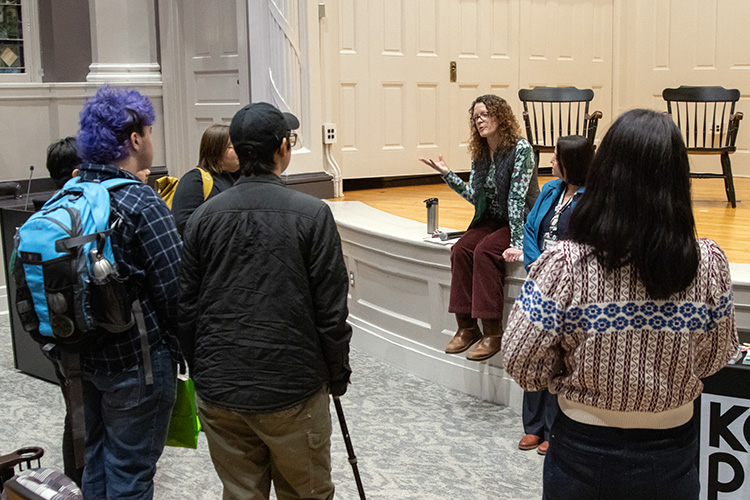
This Election Day, Washington College students fulfilled one of the central responsibilities of living in a democracy, voting for their preferred candidates.
To help Washington students get prepared to vote, Thomas V. Mike Miller Director of Civic Engagement Pat Nugent and Assistant Dean for Student Affairs Tricia Biles used funds from the Holstein Program in Ethics to hire voter engagement interns to visit classrooms and encourage classmates to begin forming “voting plans.”
Discussions on voting plans are just one part of being civically engaged. As students at the first college specifically designed to train citizen leaders, Washington students learn not only about the importance of voting, but also that civic duty extends so much farther.
They take advantage of opportunities to engage in the local community, using Chestertown and Kent County as real examples of the impact of planning, policy, and decision-making. With the gubernatorial election this year, these opportunities have been particularly far-reaching.
“It’s incredible how many of these opportunities are available to students across our campus,” Nugent said, “from campus-community events, to credited and paid internships, to community-engaged research.”
Before students can vote for the candidates who best represent their interests, values, and vision for the community, they must first develop their understanding of how civic change happens and learn how politicians, public figures, and civic organizations work to make an impact for our towns, state, and country.
To help students with this process of discovering their own beliefs and learning about others, departments and organizations across campus consistently bring experts to campus for discussions and panels that get students thinking about their civic role and responsibilities.
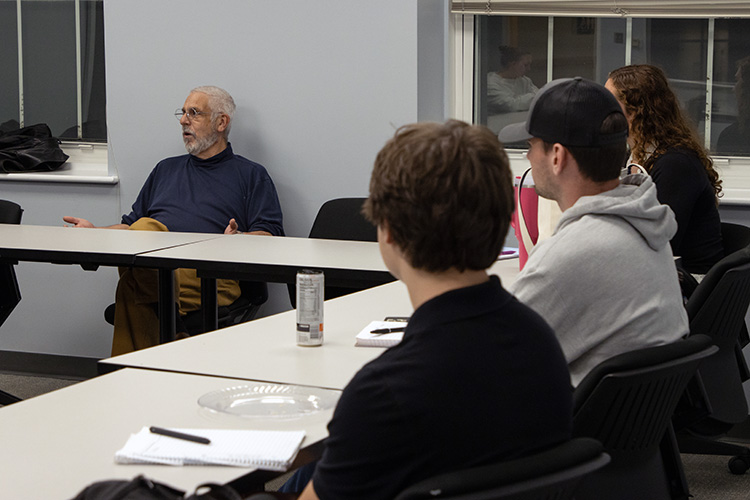 PoliTalks, an educational club founded on the belief that students deserve a safe,
respectful forum for political education and conversation, has hosted several events
over the past few weeks, as well as a midterm election results watch party.
Leading up to the election, the group held a debate night to encourage respectful discourse on current events and political issues and hosted a talk by Steven Cash, executive director of The Steady State, a nonprofit organization of former senior national security professionals striving to educate the public and advocate for constitutional democracy, the rule of law, and the preservation of America’s national security institutions.
In its first semester this fall, the Hogan Institute invited politicians and their teams from both sides of the aisle to campus to discuss issues their administrations have faced and the importance of effective and respectful communication in public service.
Like PoliTalks, the Hogan Institute is also continuing with some post-election programming by hosting and taking students to the Ronald Reagan Common Ground Forum with Governor Larry Hogan and Governor Terry McAuliffe Thursday, Nov. 5 at the Ronald Reagan Institute in Washington, D.C. The former governors will discuss how leaders move from campaigning to governing, find common ground without abandoning principle, and deliver results in a divided political environment.
In addition to considering multiple perspectives and committing to working together in a respectful way, civic engagement also requires the preservation of a social environment that allows for those interactions modeled by PoliTalks and the Hogan Institute to take place. Last week, the Miller Library teamed up with the Kent County Public Library, The Needle’s Eye Academy, We Need Diverse Books, and more to host a film screening of The Librarians, a documentary about book bans in schools and public libraries.
“We have such an engaged, civic campus that we thought it was the perfect place to have these conversations to connect it to other areas,” said Andrea Boothby-Rice, research and instruction librarian at Miller Library, adding that book banning policies are not just about libraries but also education, civic engagement, and first amendment rights. “I really wanted students to be introduced to this idea that these things are happening and the impact is pretty far reaching.”
Following the screening, there was a panel discussion on the importance of protecting the freedom to read by making materials available regardless of their political viewpoint.
But once all the discussion and consideration and even voting is done, true civic engagement requires still more. The actual work of public service involves gathering public feedback and establishing plans that guide the work of government.
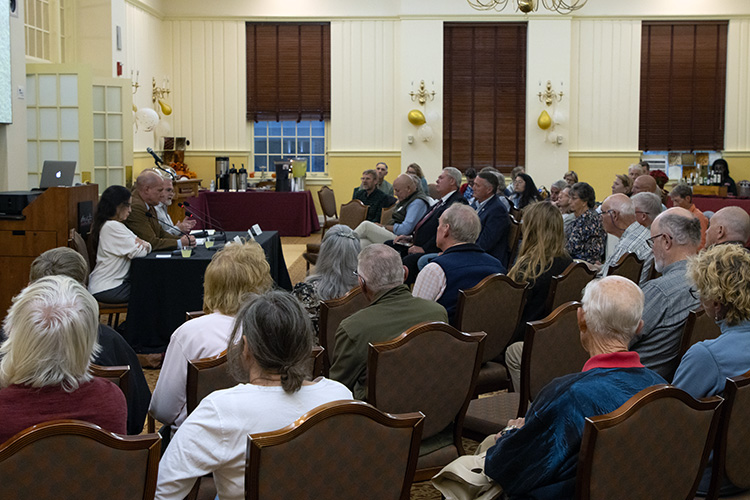 Shortly before the election, the Holstein program partnered with Eastern Shore Land
Conservancy and Kent Conservation and Preservation Alliance to host the Kent County Comprehensive Plan Forum, connecting a variety of professionals, candidates for local office, and members
of the public to talk about the plan, the guiding principle for the future growth
and development of the county. The comprehensive plan, and the forum to work on it,
provide a venue for the community to articulate strategic, economic priorities while
maintaining aspects of the county’s identity like agriculture, shorelines, and heritage.
Beyond just hosting events, departments across campus provide internships at local non-profit and government agencies, including Minary’s Dream Alliance, Kent Attainable Housing, Community Mediation Upper Shore, the Kent County Local Management Board, and more.
Students also have classroom opportunities to engage with local issues. Community-engaged research is perhaps the most powerful way staff, faculty, and students are contributing to the community as informed and active citizens. Media and Information Literacy as Civic Practice includes essays by 29 College staff and faculty, exemplifying just how broad and dynamic this cross-campus effort is.
“We are asking students to truly engage their community within the research process,” Nugent said. “We ask them not simply to share their research with the community, but to answer research questions that are generated by our community partners.”
Many of our academic departments offer course-based research projects, where professors and students spend the semester serving community partners through their collaborative research. For example, the political science department offers a State and Local Politics course in which students answer research questions posed by the Kent County Local Management Board’s Uptown community group KNOCK (Kids and Neighbors Organizing for Change in Kent County). Students in this course don’t simply present their research to a professor; they will be presenting their findings to a room full of community leaders interested in turning their research into action.
“Whether service, events, internships, or course research, Washington College is providing an incredible array of opportunities and support systems to not only inspire students to be civically engaged, but to develop within them the tools and ethical frameworks that allow them to be effective civic actors now,” Nugent said.