
Students Help Peers Make Voting Plans
Nonpartisan Voter Engagement Interns are engaging students in thinking through how they plan to participate on election day.
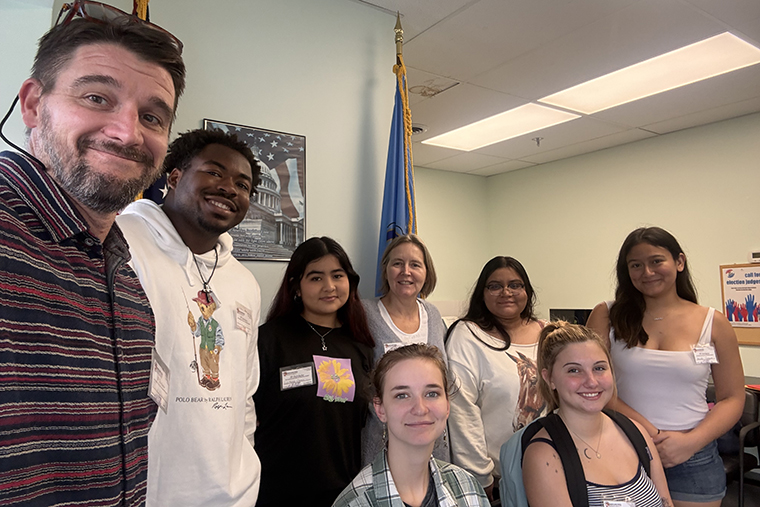
Photo caption: Pictured from left front row: Amy Tokash '29 and Sarah Behm '29; back row: Pat Nugent, Terrance Vincent '27, Lia Olmos '29, Tricia Biles, Kat Abzun '29, and Amanda Campino '28.
What’s your plan for Tuesday, Nov. 3?
That’s the date of this year’s gubernatorial election, and groups across campus are helping make sure students are prepared to vote.
For the second time, the Office of Student Affairs, the Holstein Program in Ethics, and the Starr Center for the Study of the American Experience teamed up to get students not only thinking about the election, but plan how they are going to participate in it.
Assistant Dean for Student Affairs Tricia Biles and Thomas V. Mike Miller Director of Civic Engagement Pat Nugent have hired a team of six nonpartisan voter engagement interns. Since September, these interns have visited classrooms to engage their classmates with forming their own “voting plans.”
“Students may have an intention to vote, they may believe that they’re registered, but then they have all sorts of logistical hurdles on the day,” Biles said.
At each class visit, interns pose the same six questions and provide personal anecdotes about their own voting plans and experiences. Those questions are: Are you registered to vote? Where are you registered to vote? Where is your polling place? Can you vote by mail or absentee ballot? When is your absentee ballot request deadline? What’s on your ballot?
By working through these questions, students know if they need to register, can decide whether they want to register in their hometown or Chestertown as residents of the College, where their polling place is and how to get there for in-person voting, and more.
“If the question you ask students is ‘are you registered to vote?’ 99 percent of them will say ‘yes.’ If the question you ask is ‘do you have a plan for how you’re going to vote,’ that opens up all sorts of conversations and questions that really are important to impacting our students’ ability to get to the polls,” Nugent said.
By starting these conversations in September and October, students are given the time to think through these answers and create the best voting plan for them.
For some Washington College students, this election will be the first time they are eligible to vote. For others, it will be the first time they take advantage of that right.
Amy Tokash ’29 and Lia Olmos ’29 are among this year’s cohort of nonpartisan voter engagement interns. They are both first-time voters this election.
Olmos said she became a voter engagement intern because she felt it was an opportunity to share information and resources to get young people—often lauded as the future but not necessarily knowledgeable about the process—to be informed in their vote.
Olmos is coordinating the classroom visits and said more than 15 faculty members reached out to her about presenting in their classes. The team also presented at a Senate meeting of the Student Government Association.
“It seemed like I was opening a door … to something they hadn’t thought of before,” Tokash said of the presentation she gave during a classroom visit.
These presentations are intentionally designed to be led by students as part of the College’s student-centered support model.
“We recognize that students seek information and support from their peers first, so the messaging coming from their peers is exponentially more impactful. If they’re seeing their peers are engaged and informed, then it stimulates something within them,” Biles said.
Presentations last about five minutes and are typically scheduled at the beginning or end of a class period.
“It makes it less intimidating for the students who are doing it, much more feasible for the professors incorporating it into their classes, and digestible for listeners,” Biles said.
The other voter engagement interns are Terrance Vincent ’27, Kat Abzun ’29, Amanda Campino ’28, and Sarah Behm ’29. This is Vincent’s second time participating in the program.
The voter engagement interns, Biles, and Nugent also received training from the Kent County Board of Elections Office to be voter registration distributors.
“It gave our students a real sense of the responsibility involved and the gravity of what it means to get out the vote in a nonpartisan way,” Nugent said.
Behm keeps her voter registration distributor card in her wallet and registration forms in her backpack to hand out to students who are interested in registering to vote in Kent County. She’s had two students take the documents from her so far, while many more have opted to register themselves online.
Whether students vote in Chestertown or wherever they call home, Nugent is encouraging them to engage in the campaign events and forums in Kent County to engage with the community and explore local politics.
“If our College is committed to inspiring and supporting emerging citizen leaders, which I believe it is, then it really has to be supporting students to vote while they are still here at Washington College,” Nugent said. “It’s such a great opportunity for us to lean in to what it means to be a citizen leader, and one that is both tangible and accessible. We’re really enjoying doing that.”
Growing up, Behm saw the presidential vote as the most important item on the ballot. In getting older, she realized she could make a huge change on the local level.
“Change starts small,” she said, noting that Washington College students are very engaged in on-campus politics, working with the SGA or using clubs as avenues to get active and make a change, and that voting in state and local elections is another major component for students to take advantage of.
“It’s our responsibility … it’s not just on our parents,” Tokash said.
—MacKenzie Brady ’21