
New Book by Nearly 30 Washington Faculty Members Leads the Way on Teaching Civic and Information Literacy
Joint effort organized by co-directors of the Cromwell Center on Teaching and Learning use courses taught at the College to illustrate ways faculty can prepare students to be citizen leaders by helping them build their media and information literacy.
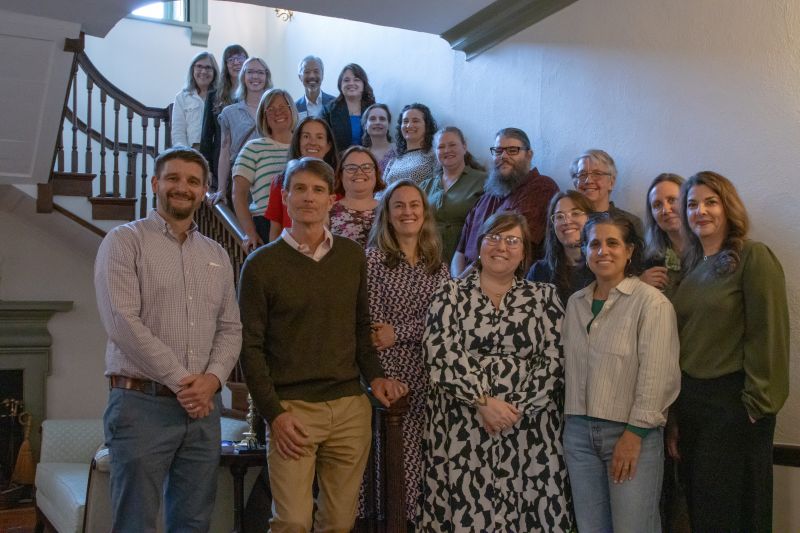
With the country celebrating the 250th anniversary of the Declaration of Independence this week, Washington College faculty once again are bringing the institution’s founding mission to train citizen leaders into the modern age, as they have since 1782, this time with a new book meant to help professors throughout the country do this vital work.
“Media and Information Literacy as Civic Practice” connects two essential aspects of higher education—critical thinking about information sources and active citizenship—through an introduction providing explicit theoretical grounding and 23 chapters that relate how those principles have been applied in classes in more than a dozen disciplines at Washington, inviting faculty everywhere to find ways to do the same in their own lecture halls. The book was led and edited by the co-directors of the Cromwell Center for Teaching and Learning at Washington, Meghan Grosse, chair of the communications and media studies department, and Sara Clarke-De Reza, chair of the education department.
“We want to show people in any discipline that they can teach critical information literacy skills in service of these democratic and civic engagement ideals,” Clarke-De Reza said. “When you read the academic literature on civic engagement, it is positioned in American studies or political science or education, traditionally civic fields. But we think there’s room for it everywhere, and we think it’s everyone’s responsibility.”
In addition to its founding as the first college in the new country and the first explicitly secular institution to train citizens rather than clergy, Washington was the ideal college to produce a book connecting information literacy with community and civic engagement for several other reasons, including the Cromwell Center, which emphasizes ongoing innovation in teaching methods. With the support of the state and former Maryland Gov. Larry Hogan, the College also created the Thomas V. Mike Miller Director of Civic Engagement position to coordinate and enhance the ways the College trains its students to be citizen leaders across the curriculum.
“Washington College is uniquely positioned to be a leader in this area given our founding mission,” Grosse said. “But it’s certainly something that’s relevant to bigger research institutions and other small liberal arts colleges.”
While Washington faculty are perfectly positioned to lead the conversation about information literacy and civic engagement and there is a need for teaching in the area throughout the country, the idea for the book itself arose, appropriately enough, through a course Grosse and Clarke-De Reza taught together. Students majoring in either of their fields, and many others in the social sciences, need to learn specific research methods like surveying and content analysis, the two professors realized they could increase student engagement and show them how these skills can have tangible benefits by creating a project-based course. For the first two years they offered the social sciences research methods class together, Grosse and Clarke-De Reza had students apply the methods they were learning to critically evaluate the state of civic engagement at Washington College and then make recommendations to further incorporate the practice into campus and academic culture.
The result was not only enhancements in College teaching, communications, service, and more, but also increased understanding by the students that they were civic actors with the necessary skills, agency, and responsibility to get involved.
Seeing the multiple successes of the approach for themselves and understanding that Washington’s focus on community and civic engagement meant faculty across disciplines are doing their own work to integrate such work in their own classes, Grosse and Clarke-De Reza realized there was an opportunity to bring everyone together and expand the impact of their work beyond just one campus.
Especially in their role as co-directors of the Cromwell Center for Teaching and Learning, the duo also saw the value a book detailing Washington faculty’s varied experiences bringing information literacy and civic engagement into the classroom could offer faculty elsewhere. In most disciplines, professors are not taught in their graduate programs how to teach, or even how to talk about their work with non-experts. A book not only showing the value of these elements in teaching but providing case studies on ways it can be done would speak directly to that unfortunate lack in the academic system.
 Writing in the foreword to the book, Thomas V. Mike Miller Director of Civic Engagement
Pat Nugent endorsed the value of the text for helping faculty at any college or university
in any discipline finding ways to incorporate information literacy and civic engagement
into their teaching.
Writing in the foreword to the book, Thomas V. Mike Miller Director of Civic Engagement
Pat Nugent endorsed the value of the text for helping faculty at any college or university
in any discipline finding ways to incorporate information literacy and civic engagement
into their teaching.
“While they differ across discipline, course, and projects, the questions raised by the many authors in this book are key for an institution developing and designing a civic education program,” Nugent wrote. “Collectively, this manuscript provides a framework for thinking through how to engage students in civic reflection and civic action across a continuum of educational experiences, both inside and outside the classroom and through credited coursework and paid internships...this book offers numerous models to prepare students for today’s challenging social, political, and media landscapes.”
The broad value of the book is largely created by the breadth of the writers, disciplines, and courses discussed in it. It is organized in four parts that showcase four basic information literacy skills as applied to civic work, with each illustrated by five or six chapters drawing on different courses. These range from computer science professor Shaun Ramsey guiding programmers through designing voting districts and the thorny problem of gerrymandering to English professor Sean Meehan helping students understand rhetoric and how it works to shape our understanding of social and political issues. Professors of anthropology, biology, business, environmental science, political science and more describe how they engaged students with topics ranging from crime data to human rights and the lessons both teachers and students took away from the experience.
Just as Washington College has led training of citizens historically and is innovating on how to do it in the future, “Media and Information Literacy as Civic Practice” encompasses both this large variety of examples with a universal framework that helps unify the text and the work.
In discussing the work, Clarke-De Reza emphasizes the dual approach of teaching students specific skills, like how to research sources, and cultivating certain dispositions in students, such as building a habit of examining multiple perspectives when investigating any issue.
Grosse adds to the idea by noting that the rate of change in technology and the information landscape means that skills today, while essential, can quickly become outdated, which is why the liberal arts strength in developing dispositions and more fundamental principles that underlie the need and ways information is evaluated is even more important.
The introduction to the book that they wrote together makes this case in detail and depth.
“Colleges and universities can use their resources to bridge the gap between the individual and the broader community, working to establish civic mindedness alongside content knowledge,” Grosse and Clarke-De Reza wrote. “Having a functioning democracy relies on people who can distinguish between information types, parse the interests that shape our information landscape, and develop nuanced understandings of complex social problems.”
— Mark Jolly-Van Bodegraven