
Washington Students Learn from Living Writers
The English department course, in collaboration with the Rose O’Neill Literary House, brings authors to campus to share their work with the public and help students with their own writing.
When students come to Washington College, they join a unique community. It is a community of scholars, athletes, leaders. And it is a community of writers.
Learning to communicate effectively is built into every student’s education, from the first-year seminar to the senior capstone project. And for students who want to write for non-academic settings, there are four student-run publications; minors in creative writing and journalism, editing and publishing; the Writers’ Union student organization; and of course the Rose O’Neill Literary House.
Students are consistently introduced to the larger writing community and industry as well, including through the Living Writers course, which is taught every two years rotating through a focus on fiction, poetry, and creative nonfiction. The professor teaching the course works with the Lit House to bring several writers to campus during the semester for readings, craft talks, and class visits.
This year, Lit House Associate Director Roy Kesey is teaching the fiction version of the course, featuring climate fiction in a class that mixes literary analysis and creative writing.
“It’s one of my favorite courses to teach, and this is my second time teaching it,” Kesey said. “The course can be primarily a literature course, primarily a creative writing workshop, or a hybrid of the two; in a nod to some of the new species that show up in the climate fiction we’re reading, my version this year is hybrid. The discussions are primarily looking at the books as literature, but each student will also workshop pieces of their own climate fiction and turn in a portfolio of climate fiction in place of a final exam.”
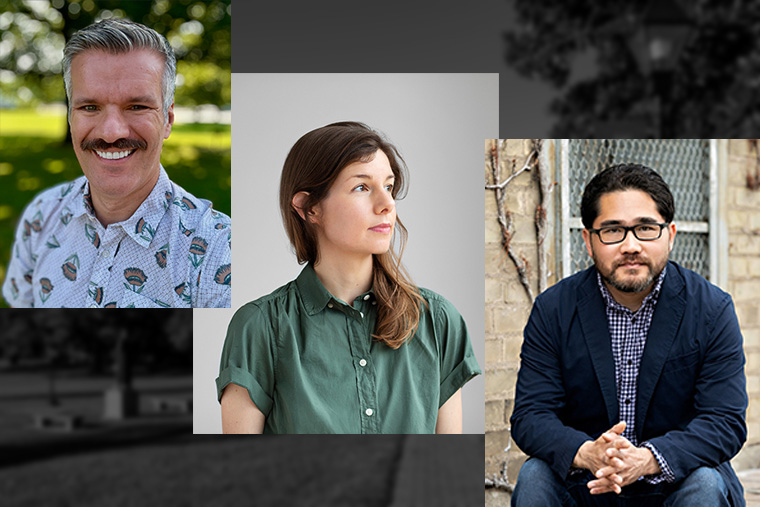
The three writers visiting for the Living Writers series this year are Matt Bell, Allegra Hyde, and Sequoia Nagamatsu, all of whom Kesey characterized as having “made notable and varied contributions to the field of contemporary climate fiction.”
Bell will be the first to come to campus and is giving a public reading at 6 p.m. on Wednesday, Sept. 30 in the Lit House. Hyde will read on Oct. 28, and Nagamatsu will share his work with the public Nov. 18. All three are also offering second public sessions, either generative workshops or craft talks, the following day.
All public readings are also livestreamed for people who cannot make it to the Lit House. The full schedule of public Lit House events is available on the College website.
In addition to the public events, each participating Living Writer also engages directly with the students in the course in visits to the class.
“We’re careful to pick visiting authors who are not just great writers,” Kesey said, “but also great teachers who are enthusiastic about the opportunity to interact extensively with Washington College students, faculty and staff, as well as the greater Chestertown community, in the course of their events.”
Living Writers Fiction Series
Matt Bell
Sept. 30
Matt Bell reads from his fiction.
Oct. 1
"Refuse to Be Done": a craft talk by Matt Bell.
Matt Bell’s next novel is Penitent, forthcoming in 2028 from Doubleday Books. He is the author most recently of the novel Appleseed (a New York Times Notable Book) and the craft book Refuse to Be Done, a guide to novel writing, rewriting, and revision. He is also the author of the novels Scrapper and In the House upon the Dirt Between the Lake and the Woods, as well as the short story collection A Tree or a Person or a Wall, a non-fiction book about the classic video game Baldur's Gate II, and several other titles. His writing has appeared in The New York Times, Esquire, Tin House, Fairy Tale Review, American Short Fiction, Orion, and many other publications. A native of Michigan, he teaches creative writing at Arizona State University, where he directs the ASU Worldbuilding Initiative.
Allegra Hyde
Oct. 28
Allegra Hyde reads from her fiction.
Oct. 29
"Non-Human POV in Climate Fiction": a generative workshop led by Allegra Hyde.
Allegra Hyde is the author of the story collection The Last Catastrophe, an Editors’ Choice selection at The New York Times and a finalist for the Ohioana Book Award. Her debut novel Eleutheria was named a best book of the year by The New Yorker and shortlisted for the VCU Cabell First Novelist Prize. Her first story collection, Of This New World, won the John Simmons Short Fiction Award. She currently teaches at Smith College.
Sequoia Nagamatsu
Nov. 18
Sequoia Nagamatsu reads from his fiction.
Nov. 19
"Crafting the Believable: Building Character from Folklore to Tech" led by Seqouia Nagamatsu.
Sequoia Nagamatsu is the author of the national bestselling novel, How High We Go in the Dark, a New York Times Editors’ Choice, and the story collection, Where We Go When All We Were Is Gone. His work has appeared in publications such as Conjunctions, The Southern Review, ZYZZYVA, Tin House, Iowa Review, Lightspeed Magazine, and One World: A Global Anthology of Short Stories and has been listed as notable in Best American Non-Required Reading and The Best Horror of the Year.