
Basu Wins National Awards for Original Script, Poem
Senior Decides to Seek Rejection, Takes Home Major Prizes
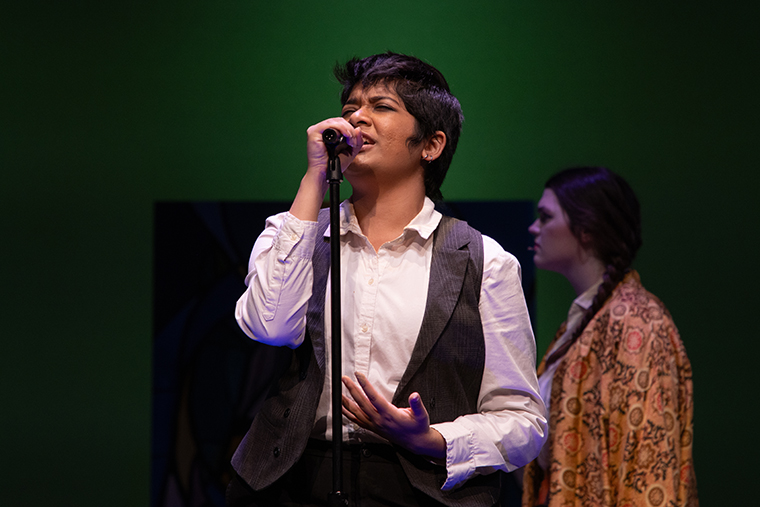
In between emails about upcoming club events and reminders about senior obligations, Jaya S. Basu '26 has recently received some exceptionally good news.
In search of rejection, Basu has been submitting their work to national prizes and literary journals with the understanding that it will likely not get accepted—because it's not the right fit for the journal, it wasn't to the taste of the editors reading it, or it just wasn't ready yet. While searching for rejection, Basu won awards for their poetry and playwriting.
Their poem “Romance of the Kitchen Sink” won the Spencer Undergraduate Poetry Award Sonnet Prize at West Chester University. And, if one award weren't enough, their original play “Mahamoha” is the co-recipient of the Nathan Louis Jackson Playwriting Award, second place recipient of the Paul Stephen Lim Playwright Award, and one of eight regional nominations for the National Partners of the American Theatre Julie Jenson Playwriting Award, all from American College Theatre Festival.
“Mahamoha” tells the story of a young transmasculine Indian American taking care of their elderly grandmother who is in assisted living, experiencing delusions and psychosis. The main character, during this time of taking care of their grandmother, begins to experience gender dysphoria and puzzle out their identity while being visited by the gods of Hindu mythology.
“They have to fight with these notions of tradition versus this new thing that's happening to them,” Basu explained of the play. “They have to battle with this idea of what is delusion and what does it mean to deviate from what has been put in front of you through thousands of years of tradition versus something that is not really new, but perceived as being new in the modern sphere.”
Basu has previously had their work published in journals and magazines. These are their first national recognitions and prizes for their work.
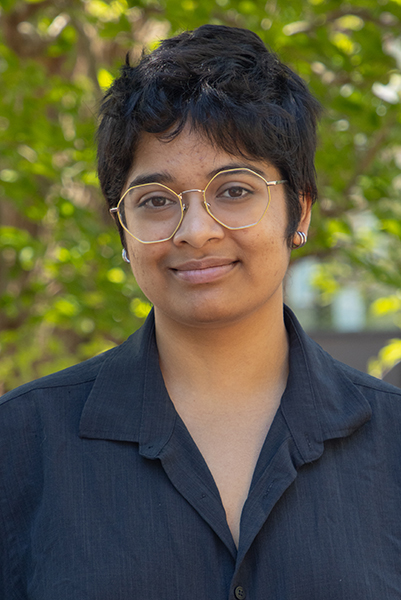 “No matter what you're submitting or where, you're going to get rejected,” Basu said.
“No matter how good of a writer you are, you're going to get a lot of rejections.”
“No matter what you're submitting or where, you're going to get rejected,” Basu said.
“No matter how good of a writer you are, you're going to get a lot of rejections.”
Knowing that rejection is an inevitability of submitting, Basu has used their senior year at Washington to take advantage of writing opportunities available exclusively for college students while they still can.
This project of seeking rejection started because Basu wanted to do something with their writing “instead of just letting it sit there.”
“I've been trying to chase rejections—get as many as I can. That's one of the reasons I got these awards and received these acceptances, is because I'm just trying to rack up rejections. When you rack up rejections, you rack up acceptances,” Basu said.
“Rejection means you tried something and put yourself out there and did something you've never done before,” they added. “I've never submitted to a poetry competition before, and I got accepted for this one. Each of those rejections in the moment is sad, but you build up a tolerance as they come in. That's something to celebrate, that you did something new and put yourself out there. That's hard and scary.”
Basu said it can be difficult to know, as a writer and editor, when a piece is finished and ready to be submitted for publications or awards.
“Sometimes you just have to put it out there,” they said. “There are a lot of pieces that I will send out and then keep editing after, whether they get published or not, because a lot of the time you're just never done. I try not to focus too hard on ‘is this piece done' and think more about ‘am I OK with this being out in the world?'”
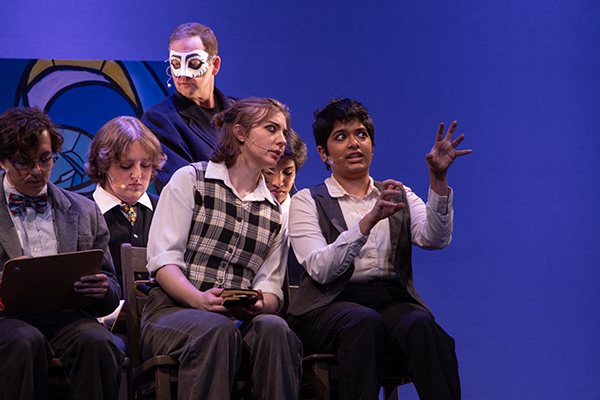
Getting their work out in the world has proven particularly fruitful for “Mahamoha.” Basu held a staged reading of the play at the T4T4T Festival (Trans4Trans4Theatre) in Baltimore over the summer.
“It was a really overwhelmingly positive response. I got a lot of really positive feedback and people really cared about the piece and it really resonated with them,” they said of that reading. “That is something that really drove me to want to do more with it and bring it to more people if I could.
 “Writing is such an internal process, but playwriting is so inherently social; theater
is a very social, empathy-driven medium,” Basu added. “When you're writing by yourself,
it can be really difficult to know if your writing means anything, if it's meaningful
to anyone else.”
“Writing is such an internal process, but playwriting is so inherently social; theater
is a very social, empathy-driven medium,” Basu added. “When you're writing by yourself,
it can be really difficult to know if your writing means anything, if it's meaningful
to anyone else.”
“Mahamoha” is Basu's first full-length play “that I feel really proud of, that I feel like I got right.”
While at Washington, Basu has taken several playwriting workshops and is currently enrolled in advanced playwriting, which focuses largely on the editing process.
Like many Washington College writers, Basu writes across genres, deploying whichever will best suit the piece at hand.
“I think it's important to have a good idea of things like genre and the different hallmarks when considering what you're writing,” they said. “The things that make a good play are not the things that make a good screenplay, so sometimes you start writing a play and you're like ‘I'm seeing this in my mind as a film, which means it's maybe not a play,' or ‘I'm spelling this out too much when I'm writing, maybe it's not a poem, maybe it's an essay.' Sometimes you can play around and see what happens and sometimes you have to think about in what way you want to tell this story.”
For Basu, those genre shifts typically happen during the writing process, rather than in revision.
“I've always been a very multidisciplinary writer,” they said. “Even when I was a kid, I was writing stories and poetry, but also music and nonfiction and experimenting with journal forms and epistolary forms.”
Basu began considering writing as a potential career option in high school. Since then, they have worked on honing their craft. That's part of what brought them to Washington.
The writing program, Sophie Kerr Prize, and related opportunities afforded to Washington students were huge draws for Basu when they were looking at colleges. Other appeals: the College's location, small class sizes, the ability to get to know professors, and the passion of those on campus.
“It became one of my top choices of where I wanted to go because of how writing focused it was,” Basu said of the College. “I was very excited to be an English major and creative writing minor—I did not anticipate being a theatre major when I came here, that happened along the way.”
Basu realized a career in theatre was possible through multiple internships they completed. Those opportunities include: a stage management and costuming internship with Montgomery College Summer Dinner Theater and directing apprenticeship with the Delaware Shakespeare Company, and a playwriting experience with Russia Theatre in D.C., in addition to the staged reading at T4T4T Festival.
They were also drawn to the Senior Capstone Experience option for the theatre department, which allows students to produce a show.
“One of the things I love about the theatre department here is that they will just let you do anything,” they said. “I was a sound designer when I was a freshman. I'd never done sound before, I didn't know how to make cues or level audio in a big theatre, but they were like ‘we'll teach you and you'll learn' and I did a lot of learning on my own.
“I feel like that happens all around campus—there's not a lot of prerequisites to doing stuff. If you're willing to learn you can kind of do anything,” they added.
Basu said that taking advantage of different opportunities to try various aspects of theatre—directing, stage managing, dramaturgy, light and sound design, costuming, etc.—has improved their ability to write productions.
“Theatre is so collaborative, and it's so important to have everybody on the same page. When you do all these different things, you get a sense of what is possible,” they added.
According to Basu, being a playwright means having to decide what's important to you the writer versus what's important to the piece as a whole, and balancing those wants and needs.
“As a playwright, it's a tradeoff between what you want for the piece and what you think is possible or feasible, especially if you want to get produced,” they said.
For their theatre SCE, Basu directed and music directed the comedy Trail to Oregon. Their English SCE explored Shakespeare's King Lear and the character Edmund through a trans studies lens.
Want to hear more from Basu? Listen to our full interview at the Washington College Unhurried Conversations podcast.
—MacKenzie Brady '21