The War of 1812 comes to the Chesapeake Bay
In the Spring of 1813, British warships entered the Chesapeake Bay, and those on the Eastern Shore responded.
 Relations with England had not been the best after the Revolution, and they became
worse as England engaged in the Napoleonic War in 1803. America had purchased the
Louisiana territory from France, bolstering its war chest. Along with land along the
Mississippi, the purchase gave some land to the United States along the Canadian border,
exacerbating tensions there. England was also fighting much of the war through its
Navy and losing numerous sailors to desertion, so much so that they began conscripting
or pressing people into service against their will. Many a New England sailing vessel
was boarded searching for deserters and would leave with a few American sailors falsely
identified as British. Tension of the seas rose with cannon volleys exchanged between
the USS Chesapeake and the HMS Leopard in 1807. Congress became involved, seeking
reparations for seized seamen. By the summer of 1812, President Madison met with Congress,
and war was declared. America, still in its infancy, was about to face another war
against a formidable foe, and the Chesapeake Bay was a prime target.
Relations with England had not been the best after the Revolution, and they became
worse as England engaged in the Napoleonic War in 1803. America had purchased the
Louisiana territory from France, bolstering its war chest. Along with land along the
Mississippi, the purchase gave some land to the United States along the Canadian border,
exacerbating tensions there. England was also fighting much of the war through its
Navy and losing numerous sailors to desertion, so much so that they began conscripting
or pressing people into service against their will. Many a New England sailing vessel
was boarded searching for deserters and would leave with a few American sailors falsely
identified as British. Tension of the seas rose with cannon volleys exchanged between
the USS Chesapeake and the HMS Leopard in 1807. Congress became involved, seeking
reparations for seized seamen. By the summer of 1812, President Madison met with Congress,
and war was declared. America, still in its infancy, was about to face another war
against a formidable foe, and the Chesapeake Bay was a prime target.
The Baltimore Harbor was central for the launching of privateers that took on the British Navy. America did officially have a Navy. It was created with the Naval Act of 1794 and had six heavy frigates, one of which was the USS Chesapeake, which had already fought and lost to England. The USS Constitution, which is the oldest warship still afloat, was another. You can visit it in Boston's harbor. America pitting six ships against the entire British Navy is one of the longest shots imaginable. More ships were needed, but where were they to come from, and how would the Nation pay for them? Enter the Privateer. Privateers were privately owned ships that were armed and commissioned by the government. They would primarily go after merchant vessels, taking cargo and ships, and hampering England's economy. With the incentive that owners of the privateers were able to keep and sell the goods they took, this became a lucrative career, making fortunes for many. It also allowed the US to create naval strength at little cost. Ships favored by Privateers were sleek, fast, and still armed. They relied on speed and maneuverability over outright armament. If you are in town for the annual Downrigging Festival, you can sail on a former privateer, the Lynx, and the Pride of Baltimore II. Both ships are later reconstructions of original ships that fought in the War of 1812.
 By the spring of 1813, Britain focused on the Chesapeake Bay. Many privateers were
coming from Baltimore Harbor, so control of the Bay meant control of the sea. In March,
British warships sailed into the Bay; within a month, they had created a blockade
and started to move troops inland. Naval engagements moved up to New England, and
in 1813, the USS Chesapeake was taken and put under the control of the English Captain
Philip Broke. With the British in control of the Bay, they began to raid the towns
on both sides of the Shore. Towns would be raided and burned. Kitty Knight, in Georgetown, confronted British Rear Admiral George Cockburn and was able to spare
a few homes. St. Michael's in Talbot County became famous as “The Town that Fooled
the British.” In August of 1813, the town's residents hung lanterns in trees and on
ships' masts in the harbor, so the British barges overshot the mark, saving the town
from destruction. Portions of Rock Hall and Fairlee suffered this fate in 1814. On
the other side of the shore, our Nation's Capital was destroyed. On August 14, 1814,
the White House, Congress, the Library of Congress, and the Supreme Court were looted
and set aflame. Thanks to quick thinking by individuals like First Lady Dolly Madison
and State Department Clerk Stephen Pleasonton, some of our most valued documents and
artifacts were saved, including the Constitution, Declaration of Independence, Bill
of Rights, and George Washington's papers.
By the spring of 1813, Britain focused on the Chesapeake Bay. Many privateers were
coming from Baltimore Harbor, so control of the Bay meant control of the sea. In March,
British warships sailed into the Bay; within a month, they had created a blockade
and started to move troops inland. Naval engagements moved up to New England, and
in 1813, the USS Chesapeake was taken and put under the control of the English Captain
Philip Broke. With the British in control of the Bay, they began to raid the towns
on both sides of the Shore. Towns would be raided and burned. Kitty Knight, in Georgetown, confronted British Rear Admiral George Cockburn and was able to spare
a few homes. St. Michael's in Talbot County became famous as “The Town that Fooled
the British.” In August of 1813, the town's residents hung lanterns in trees and on
ships' masts in the harbor, so the British barges overshot the mark, saving the town
from destruction. Portions of Rock Hall and Fairlee suffered this fate in 1814. On
the other side of the shore, our Nation's Capital was destroyed. On August 14, 1814,
the White House, Congress, the Library of Congress, and the Supreme Court were looted
and set aflame. Thanks to quick thinking by individuals like First Lady Dolly Madison
and State Department Clerk Stephen Pleasonton, some of our most valued documents and
artifacts were saved, including the Constitution, Declaration of Independence, Bill
of Rights, and George Washington's papers.
 The Battles of Baltimore and Fort McHenry, the latter of which gave us our National
Anthem, “The Star-Spangled Banner,” are marked prominently in our nation's history.
But for the Eastern Shore, the most significant conflict was the Battle of Caulk's
Field. On August 31, 1814, a battle took place just west of Chestertown. British Generals
Ross and Cockburn, fresh from their sacking of D.C., set their sights on Baltimore
and wanted to use the Eastern Shore as a diversion, so troops couldn't be sent as
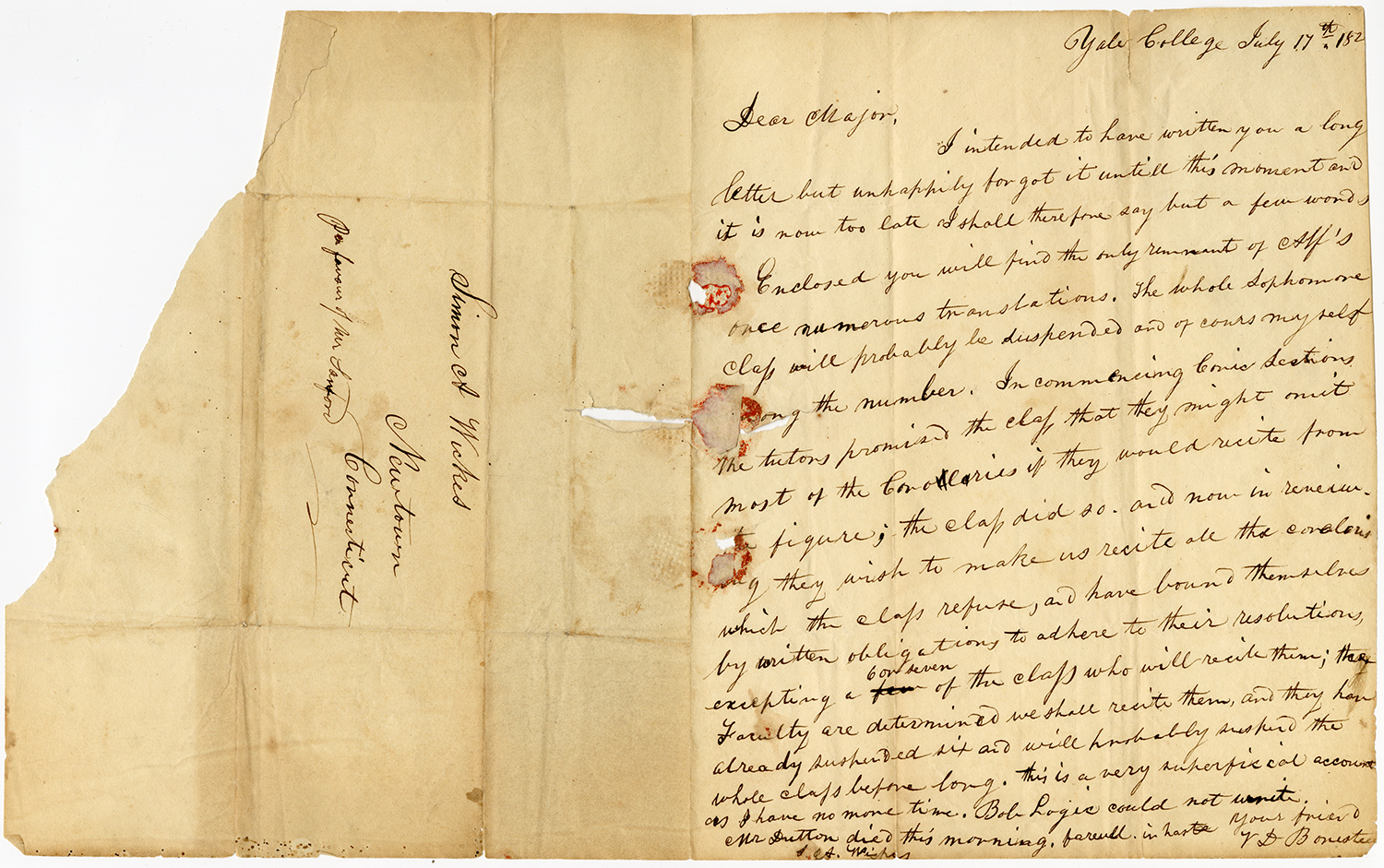
reinforcements. Maryland Militia engaged the British along the way. Maryland's 21st Regiment, headed by Lt. Col. Philip Reed, lay in wait at night in an open field belonging
to Isaac Caulk. Capt. Simon Wickes was the first to attack, firing on the British.
Wickes was outnumbered and withdrew to Reed's line. The British pushed forward, but
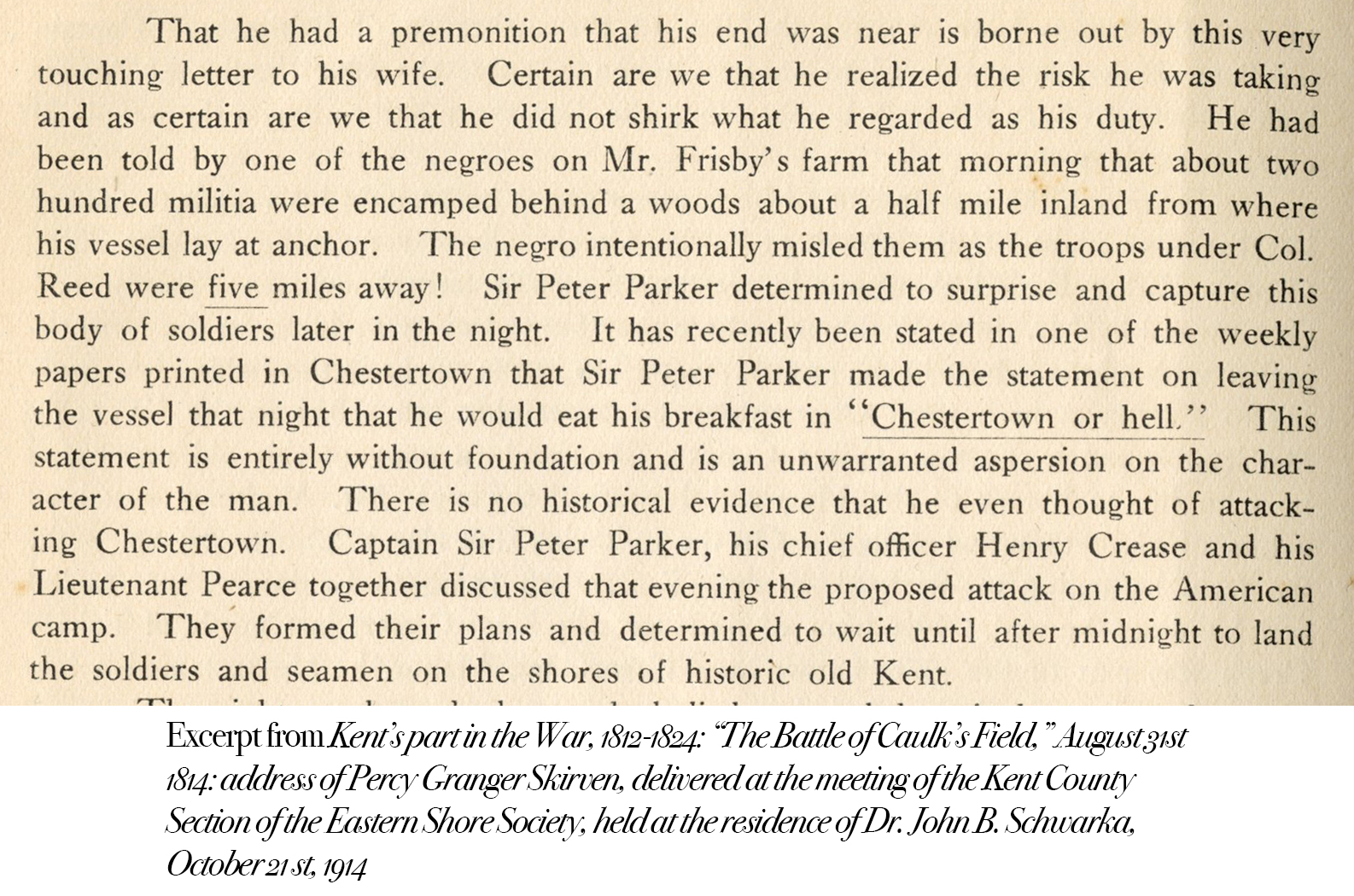
the Marylanders held. The British were commanded by Captain Peter Parker, who received
a leg wound during the battle, dying within minutes. This victory on a small field
in Kent County boosted the nation's morale, coming so soon after the destruction of
Washington and the upcoming battle of Fort McHenry.
The Battles of Baltimore and Fort McHenry, the latter of which gave us our National
Anthem, “The Star-Spangled Banner,” are marked prominently in our nation's history.
But for the Eastern Shore, the most significant conflict was the Battle of Caulk's
Field. On August 31, 1814, a battle took place just west of Chestertown. British Generals
Ross and Cockburn, fresh from their sacking of D.C., set their sights on Baltimore
and wanted to use the Eastern Shore as a diversion, so troops couldn't be sent as
reinforcements. Maryland Militia engaged the British along the way. Maryland's 21st Regiment, headed by Lt. Col. Philip Reed, lay in wait at night in an open field belonging
to Isaac Caulk. Capt. Simon Wickes was the first to attack, firing on the British.
Wickes was outnumbered and withdrew to Reed's line. The British pushed forward, but
the Marylanders held. The British were commanded by Captain Peter Parker, who received
a leg wound during the battle, dying within minutes. This victory on a small field
in Kent County boosted the nation's morale, coming so soon after the destruction of
Washington and the upcoming battle of Fort McHenry.
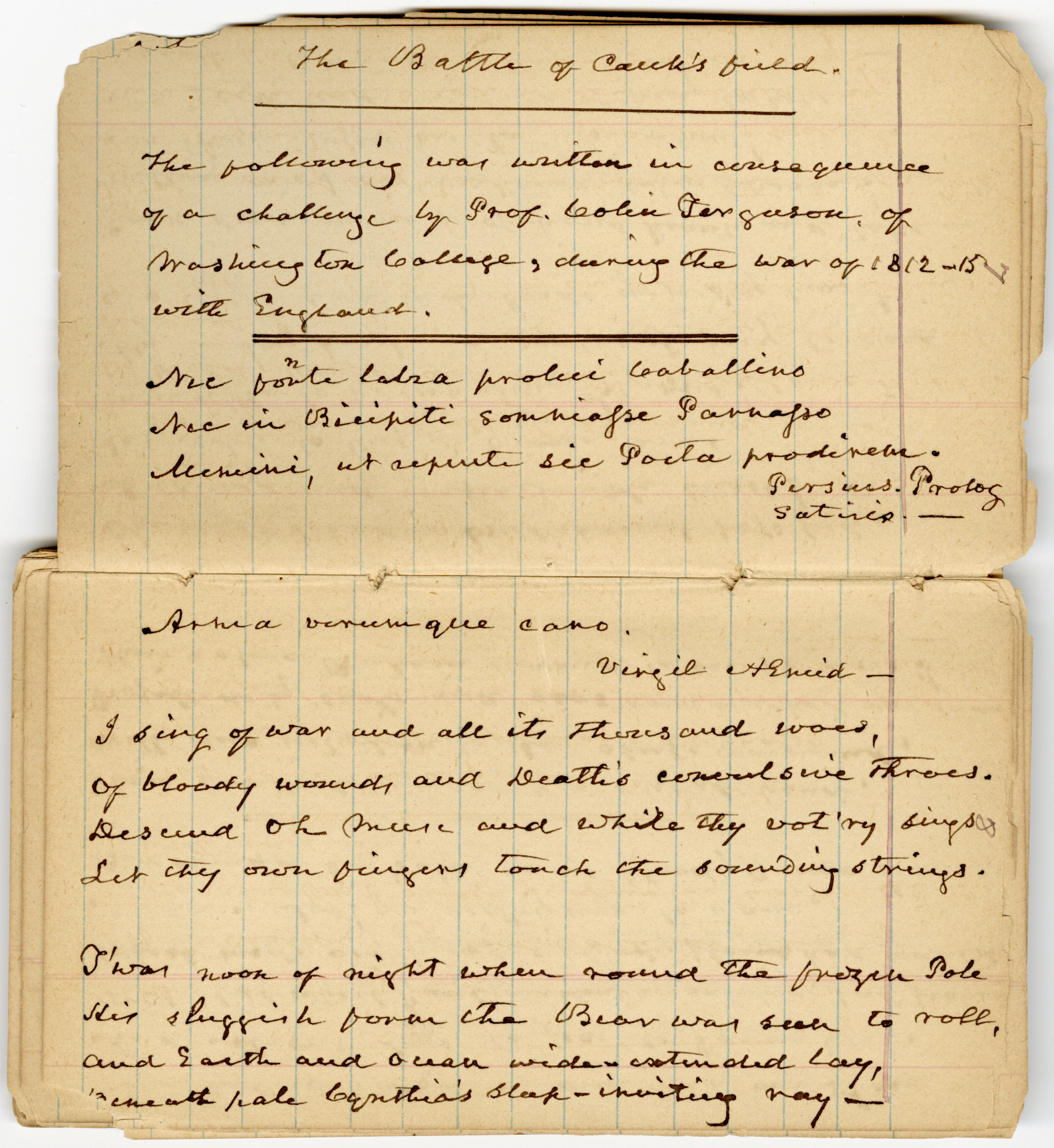
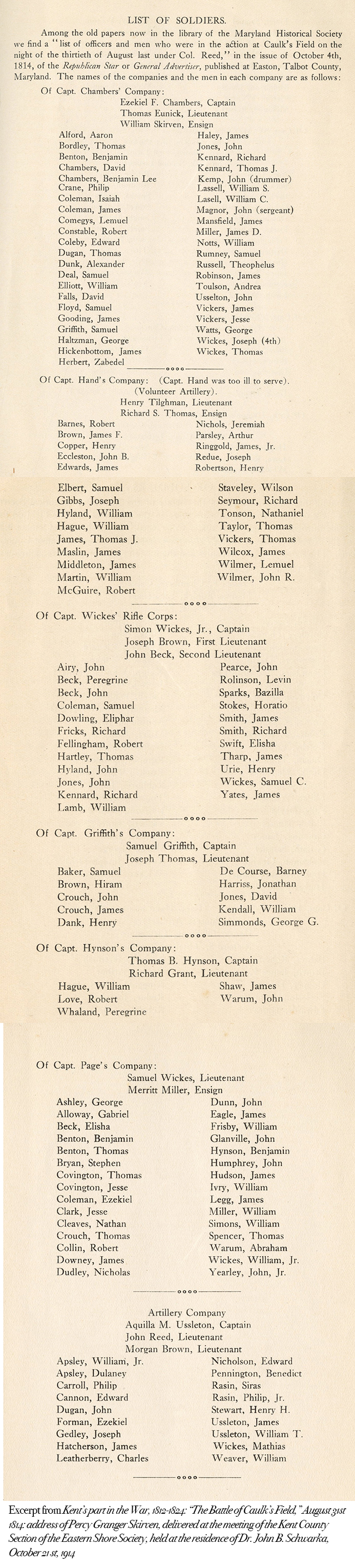
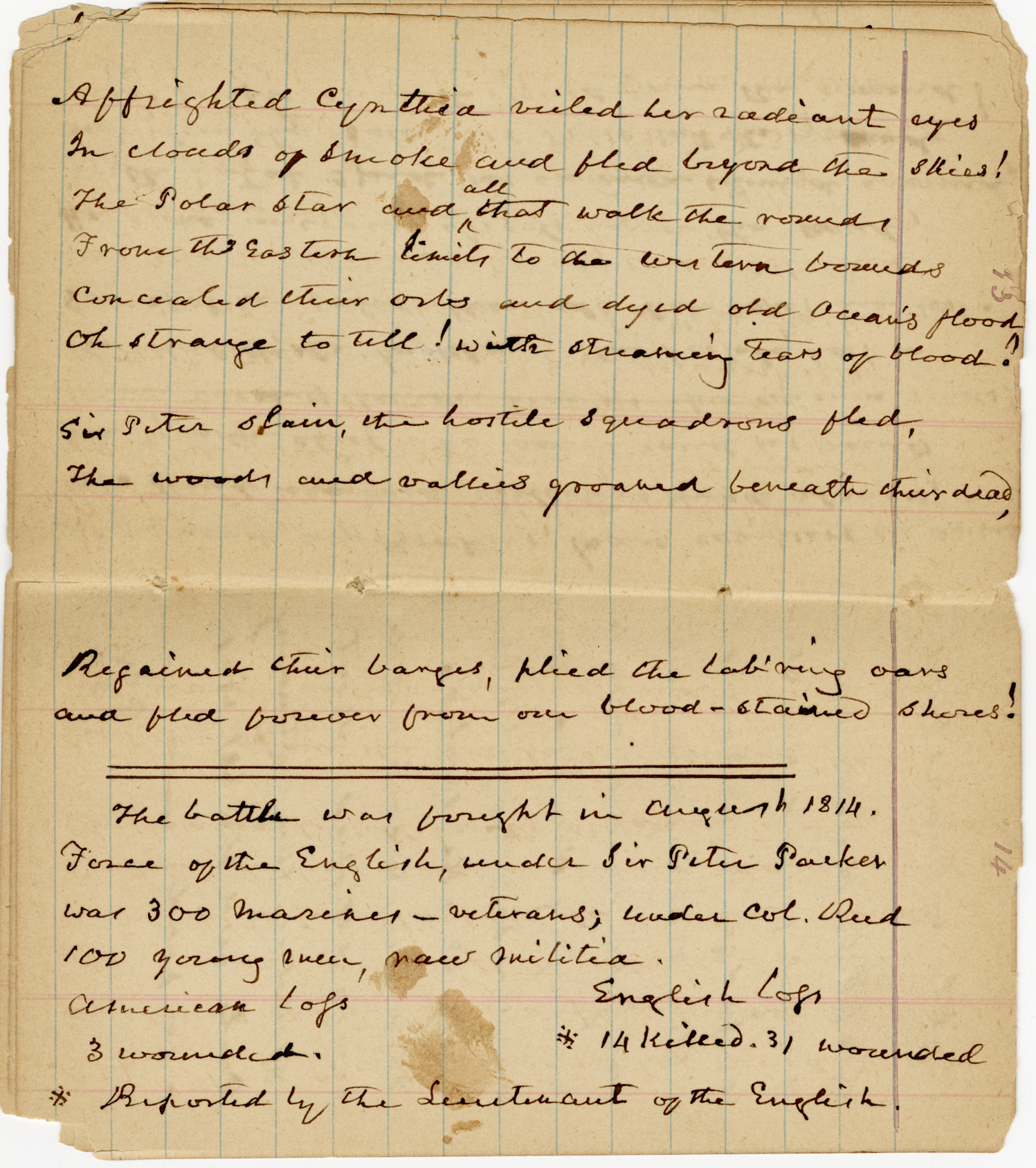 The names of those who fought are seen in our college's history and collections: Wickes, Ringgold, Wilmer, Vickers, and Chambers, to name a few. Chemistry professor Dr. Peregrine Worth did not fight at Caulks Field
but did serve as a surgeon's mate for the Maryland 8th Regimental Cavalry. Years later, fellow professor Colin Ferguson challenged him to
write about the Battle. In his “Collections of My Life,” Wroth wrote a rather poetic retelling of the battle.
The names of those who fought are seen in our college's history and collections: Wickes, Ringgold, Wilmer, Vickers, and Chambers, to name a few. Chemistry professor Dr. Peregrine Worth did not fight at Caulks Field
but did serve as a surgeon's mate for the Maryland 8th Regimental Cavalry. Years later, fellow professor Colin Ferguson challenged him to
write about the Battle. In his “Collections of My Life,” Wroth wrote a rather poetic retelling of the battle.