Maryland in the Civil War
John Wilkes Booth, his family, and his Flight through Southern Maryland
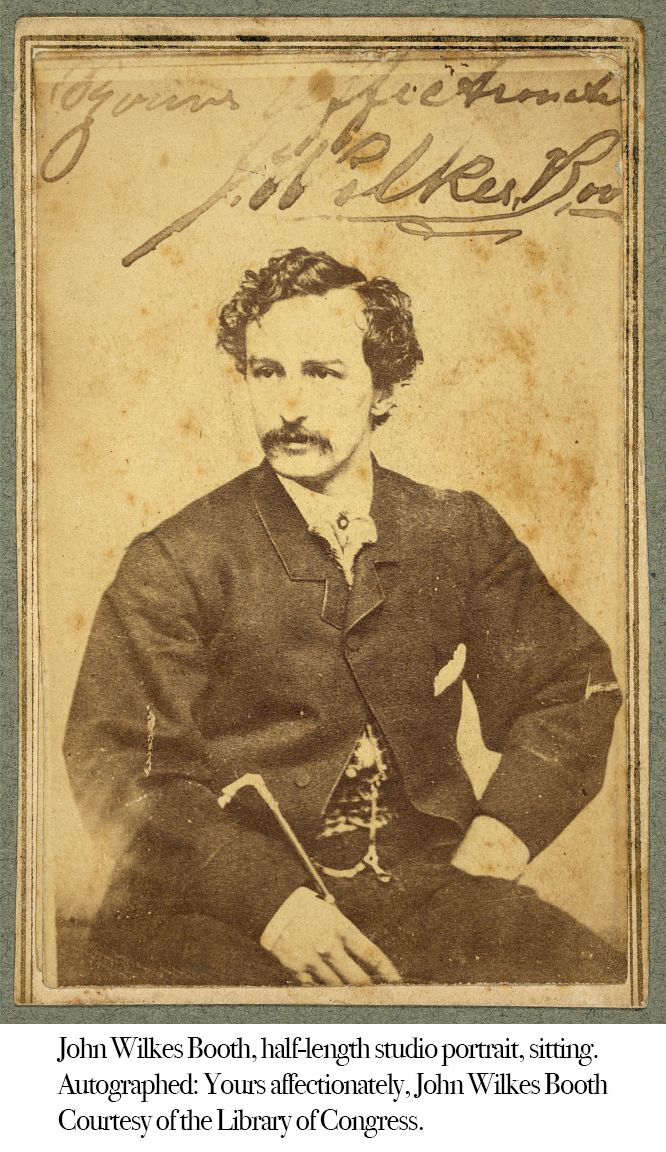
April 14 marks an unforgettable anniversary in American Civil War history: the assassination of President Abraham Lincoln during a performance at Ford's Theatre in Washington, DC. But did you know that John Wilkes Booth, Lincoln's killer, was a Maryland-born man from a colorful, illustrious family?
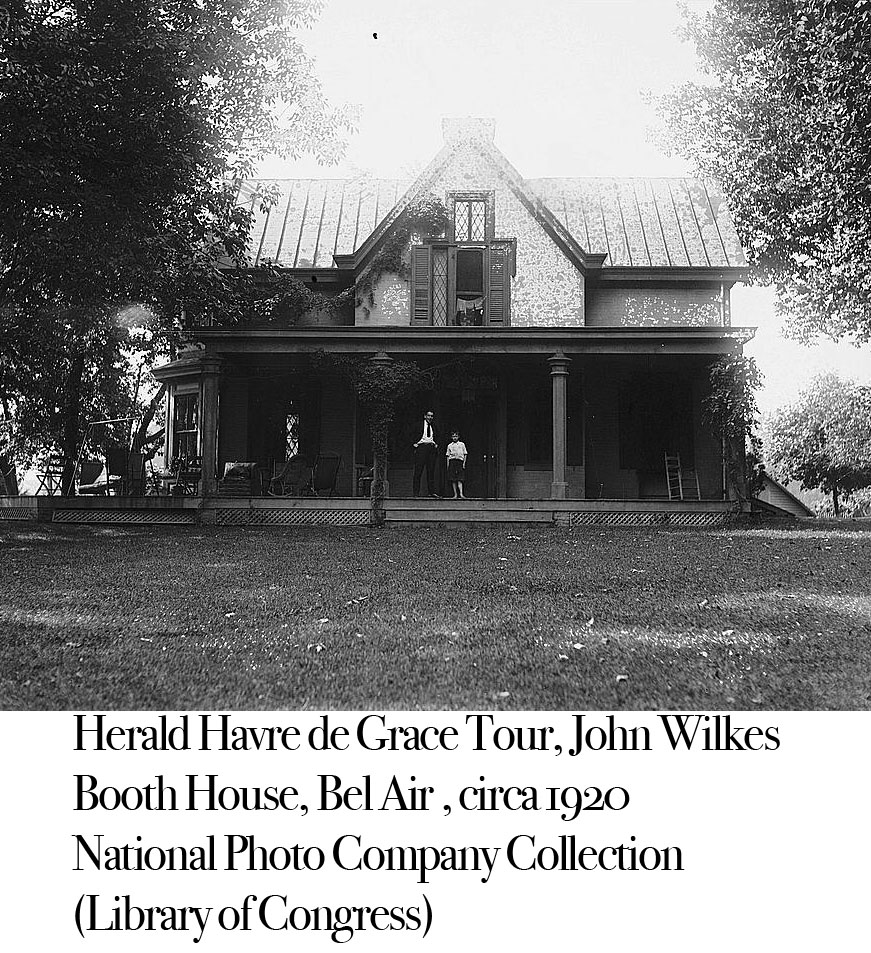 Booth's parents were Junius Brutus Booth, considered by many the greatest Shakespearean
actor of the early 19th century, and his mistress Mary Ann Holmes. The couple had fled England in June 1821,
leaving behind Booth's wife and his young son. They settled on a 150-acre farm near
Belair, Maryland with their infant son, Junius Brutus, Jr., where they lived in a
4-room log cabin. Later, they maintained a winter residence in Baltimore while building
a larger, grander residence on the Belair property, completed not long before Junius'
death. In the meantime, Junius Sr. quickly found work as an actor, playing Richard
III. Within a year, he shot to stardom on the stage as he had in England, performing
in cities up and down the East Coast and becoming famous throughout the country. He
was widely known for his eccentric ways, which were also passed along in differing
measures to some of his children.
Booth's parents were Junius Brutus Booth, considered by many the greatest Shakespearean
actor of the early 19th century, and his mistress Mary Ann Holmes. The couple had fled England in June 1821,
leaving behind Booth's wife and his young son. They settled on a 150-acre farm near
Belair, Maryland with their infant son, Junius Brutus, Jr., where they lived in a
4-room log cabin. Later, they maintained a winter residence in Baltimore while building
a larger, grander residence on the Belair property, completed not long before Junius'
death. In the meantime, Junius Sr. quickly found work as an actor, playing Richard
III. Within a year, he shot to stardom on the stage as he had in England, performing
in cities up and down the East Coast and becoming famous throughout the country. He
was widely known for his eccentric ways, which were also passed along in differing
measures to some of his children. 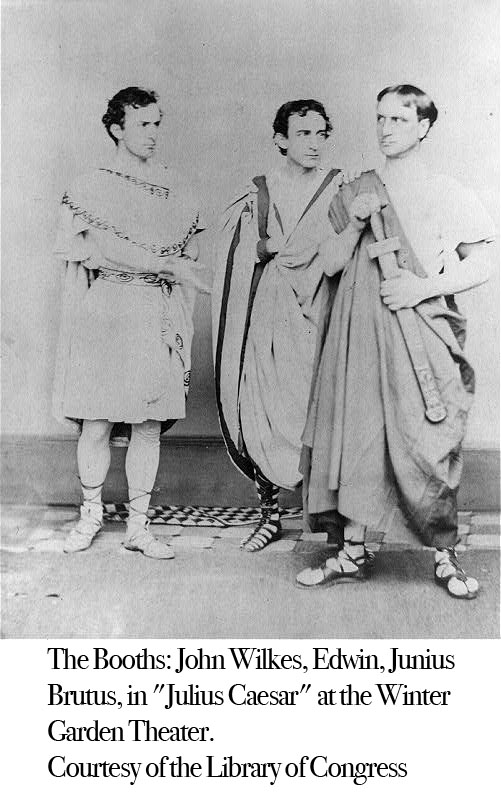 Junius and Mary Ann had 10 children between 1821 and 1840, with six living until adulthood.
Three of the sons followed in their father's footsteps onto the stage, with Edwin
Booth achieving fame that equaled or surpassed that of his father's, performing throughout
the United States and Europe. Today, Edwin is regarded by many as the greatest actor
of the 19th century. These three brothers appeared together on stage only once in a performance
of Julius Caesar in 1864. John played Marc Antony, while Junius played Cassius and Edwin played Brutus.
The proceeds from the performance were used to erect the statue of Shakespeare which
still stands in New York's Central Park. John Wilkes could have been on his way to
similar fame to that achieved later by Edwin; that trajectory was abruptly cut short,
and his art eclipsed by his crime, which has cast a shadow over his family ever since.
Junius and Mary Ann had 10 children between 1821 and 1840, with six living until adulthood.
Three of the sons followed in their father's footsteps onto the stage, with Edwin
Booth achieving fame that equaled or surpassed that of his father's, performing throughout
the United States and Europe. Today, Edwin is regarded by many as the greatest actor
of the 19th century. These three brothers appeared together on stage only once in a performance
of Julius Caesar in 1864. John played Marc Antony, while Junius played Cassius and Edwin played Brutus.
The proceeds from the performance were used to erect the statue of Shakespeare which
still stands in New York's Central Park. John Wilkes could have been on his way to
similar fame to that achieved later by Edwin; that trajectory was abruptly cut short,
and his art eclipsed by his crime, which has cast a shadow over his family ever since.
While the Booth family were staunch Unionists, John's political leanings were very different. As a young man he was allied with the Know Nothing party, which gained popularity in the 1850s. They wanted to restrict immigration, preserve jobs for the native-born, and preserve the culture and values of ‘Protestant Americans;' the group later collapsed when it became split over the issue of slavery. Booth was one of those who believed that Lincoln was an overreaching tyrant, robbing white Southerners of their right to leave the Union to start a new country where race-based slavery was universally legal.
It was late in 1864 that Booth began recruiting accomplices and forming a plan to aid the South, meeting with fellow conspirators at Mary Surratt's boarding house in Washington, DC. The original idea was to kidnap Lincoln and hold him hostage in Richmond, to effect the release of Confederate prisoners. Writing to his mother in November 1864, Booth stated his intentions:
“It seems that uncontrollable fate, moving me for its ends, takes me from you, dear Mother, to do what work I can for a poor oppressed downtrodden people...I have not a single selfish motive to spur me on to this, nothing save the sacred duty, I feel I owe the cause I love.”
The downtrodden people he spoke of were not the enslaved; they were the southerners whose economy and ‘lifestyle' depended upon the horrific institution of slavery.
Booth's plot to kidnap the President was nearly brought to fruition on St. Patrick's Day 1865, but when Lincoln's travel schedule was altered at the last minute, the plan fell apart. Then, just a couple of weeks later, Lee surrendered to Grant at Appomattox, effectively ending the war. Booth became desperate to do something for his cause, and the plot turned to murder. He soon found his opportunity. On the morning of Friday, April 14, Booth called at Ford's Theatre to pick up his mail. While there, he learned via an overheard conversation between staff that President Lincoln would be attending that evening's performance. He met with his co-conspirators at Surratt's, and they quickly made a plan to assassinate the President, Vice President Andrew Johnson, and Secretary of State William Seward all in one night.
The plan was partly successful but fatal for all the conspirators, including Mrs.
Surratt. Following the shooting at Ford's, Booth began his flight out of the city
and through Charles County, Maryland that would eventually end with his death near
Port Royal, Virginia. Of the assassination, he wrote in his diary: “I struck boldly
and not as the papers say. I walked with a firm step through a thousand of his friends,
was stopped, but pushed on...In jumping broke my leg. I passed all his pickets, rode
sixty miles that night, with the bones of my leg tearing the flesh at every jump.
I can never repent it, though we hated to kill: Our country owed all her troubles
to him, and God simply made me the instrument of his punishment.... I care not what
becomes of me.” His journal, and correspondence of the time, is full of references
to Julius 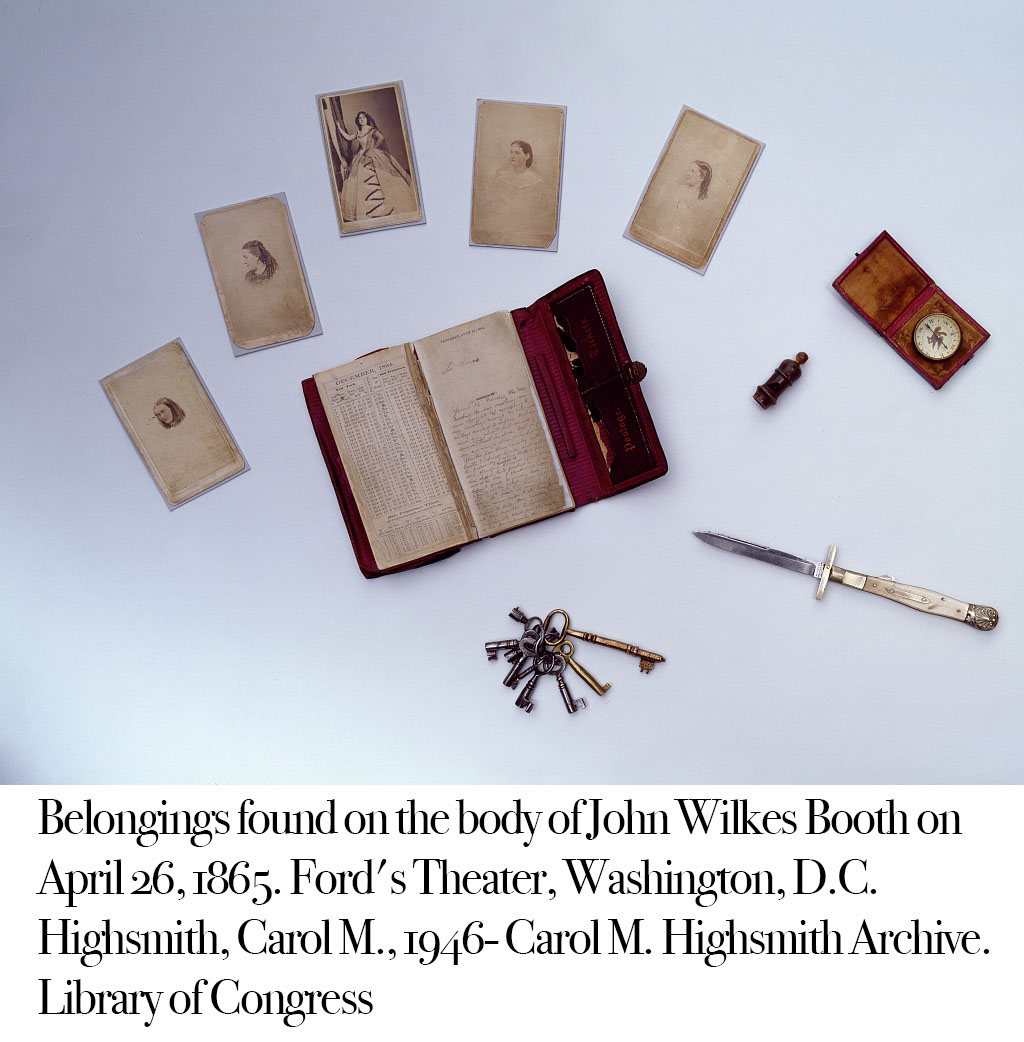 Caesar...comparing himself to Brutus, calling April 14 “the Ides.” He famously stopped
at the home of Dr. Samuel Mudd where he received medical attention and a brief rest
before continuing across the Potomac River into Virginia. Authorities caught up with
him at the Garrett farm on April 26, where he was shot to death. The other conspirators
were apprehended, and the survivors went to trial in July, and were executed by hanging.
Caesar...comparing himself to Brutus, calling April 14 “the Ides.” He famously stopped
at the home of Dr. Samuel Mudd where he received medical attention and a brief rest
before continuing across the Potomac River into Virginia. Authorities caught up with
him at the Garrett farm on April 26, where he was shot to death. The other conspirators
were apprehended, and the survivors went to trial in July, and were executed by hanging.
In a strange connection, in late 1864/early 1865, Edwin Booth saved Lincoln's son Robert from being run over by an oncoming train in Jersey City, NJ.
The details of the Booth family and the events surrounding the Lincoln conspiracies are fascinating, and the Library's Maryland Collection includes many materials related to them, including The Unlocked Book, a memoir written by Booth's sister Asia Booth Clarke, and This One Mad Act...the Unknown Story of John Wilkes Booth and His Family, written by Booth's own (alleged) granddaughter, Izola Forrester. Right or Wrong, God Judge Me, edited by John Rhodehamel and Louise Taper, is a collection of John Wilkes Booth's own writings, from both correspondence and diaries. These and many more can be found in the Maryland Collection on the library's second floor.
The Booth family's home, Tudor Hall, still stands and was added to the Historic Register in 1973. It is open for tours and special talks on most Sundays; more information can be found here: https://spiritsoftudorhall.blogspot.com/
The Dr. Samuel Mudd House and Museum is also open to visitors: https://drmudd.org/.
Information on visiting Ford's Theatre can be found here: https://fords.org/visit-us/