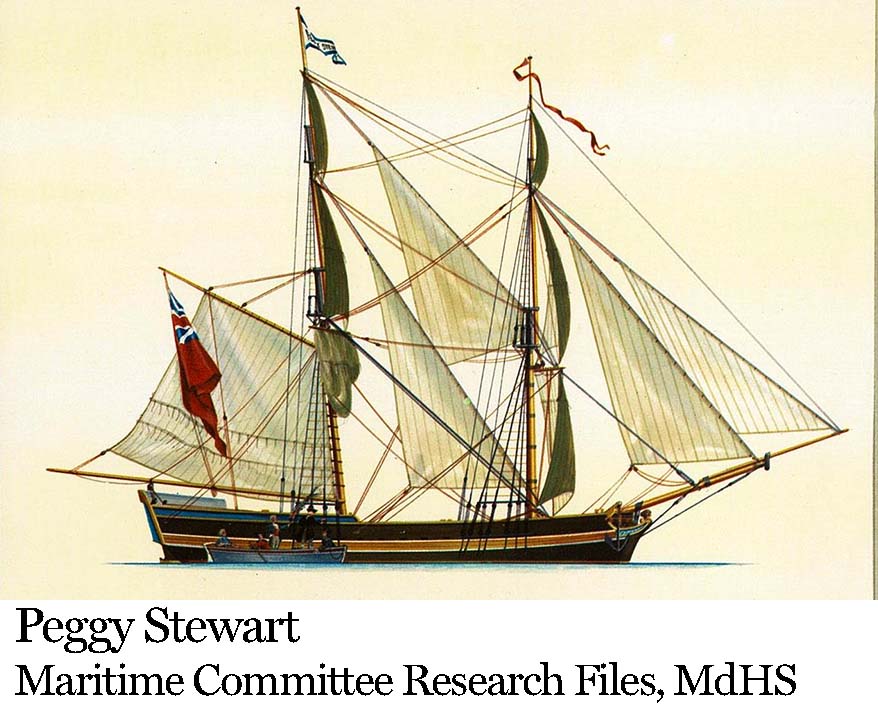
An Annapolis Tea Party: The Burning of the “Peggy Stewart”
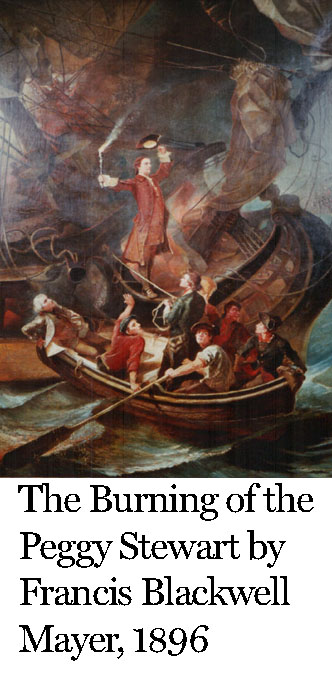
On October 19, 1774, the citizens of Annapolis watched the brig Peggy Stewart and all its cargo be set ablaze by its owner. An act of early rebellion that stayed with many who witnessed it.
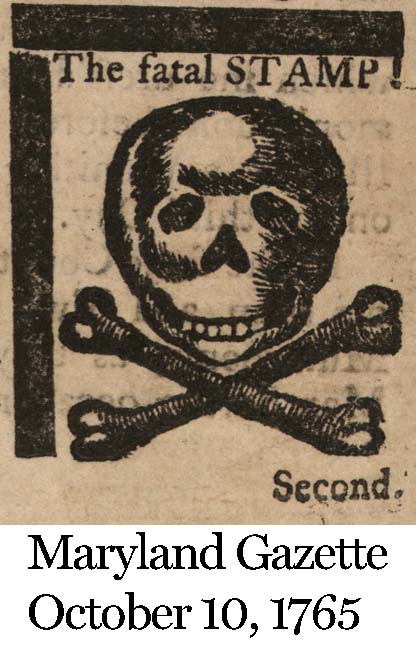 This event began nine years earlier, with the passage of the Stamp Act, the first
act passed by Parliament on the American colonists. The act required an official stamp
on numerous items, including legal and trade documents, as well as newspapers. The
colonists immediately made their protest known with boycotts and even threats against
stamp distributors. The publishers of the Maryland Gazette made their opinion known
by posting “The Fatal Stamp” on the paper instead of the one required by the act.
Despite the growing unrest, Parliament continued to directly tax the colonists, and from 1767 to 1768, it passed the Townshend Acts. These acts targeted imported and marketable goods such as tea. Although many of the Townshend Acts were repealed by 1770, the tax on tea remained. It was made official with the Tea Act of 1773. On December 19, 1773, the Sons of Liberty in Boston, dressed as Native Americans, threw 340 chests of tea into the harbor. News of the event traveled fast. Some believe that Chestertown held its own “Tea Party,” an event we celebrate at the beginning of Summer, much more comfortable for the re-enactors should they fall into the Chester River.
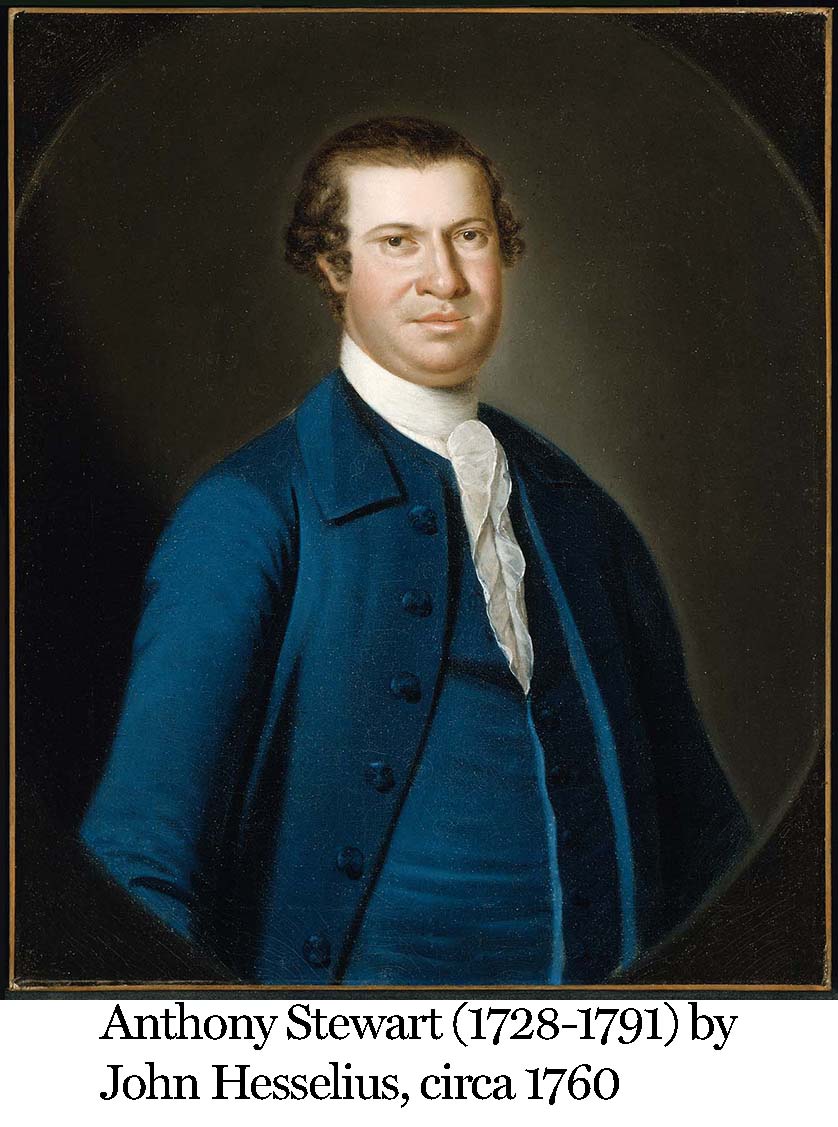 During the tensions of the early 1770s, Annapolis had formed a committee to oversee
the boycott at its port. In October of 1774, local merchant Anthony Stewart awaited
a cargo ship from England; a majority of the cargo was indentured servants, individuals
from the United Kingdom and Ireland who, in repayment for the passage, would work
a certain number of years in a household. Unbeknownst to Stewart, his partner in England,
Thomas Charles Williams, had smuggled nearly a ton of tea in seventeen crates into
the hold of the
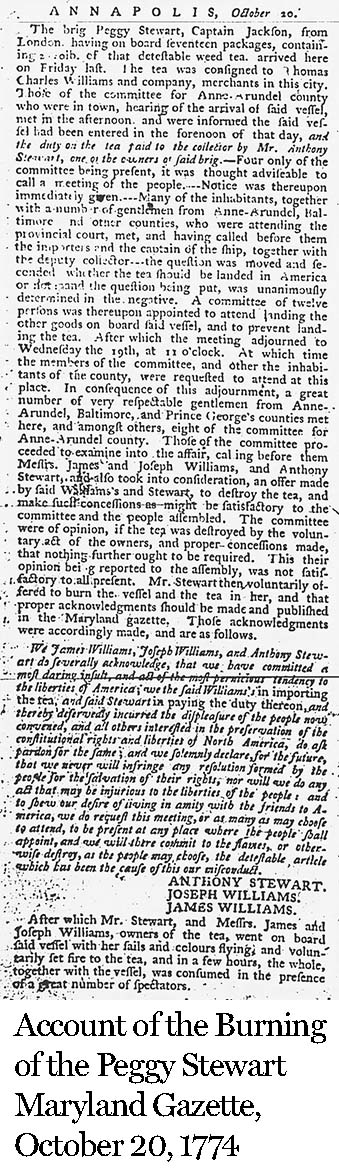 Peggy Stewart. When the ship arrived in Annapolis, the tea was discovered. If Stewart
didn’t pay the taxes on the tea, the ship and its cargo would be held until it was
settled or returned to England. If he did pay, the committee and patriots of Annapolis
would rain their ire upon him. The ship wasn’t in the best condition and would not
have fared well on a return voyage, and Stewart worried for the people on board, so
he paid the taxes.
Anthony Stewart was a merchant with Loyalist leanings, stuck between boycotts, profits,
and loyalty to the crown. When news of Stewart importing and paying taxes on tea reached
the people of Annapolis the public outcry began. It is said that gallows were erected
outside Stewart’s house. His wife had recently given birth, upping the stakes for
him and his family. There were calls to burn his house, his ship, and tar and feather
him. This last one is a horrific torture that bears little resemblance to its popular
culture depictions. It involved pouring boiling pitch on an individual, then covering
them with feathers; if they survived the initial tar, they were left with excruciating
burns over most of their body, and the tar was painful and nearly impossible to safely
remove. The committee met and negotiated with Stewart who agreed to set fire to his
ship. Despite the condition of the 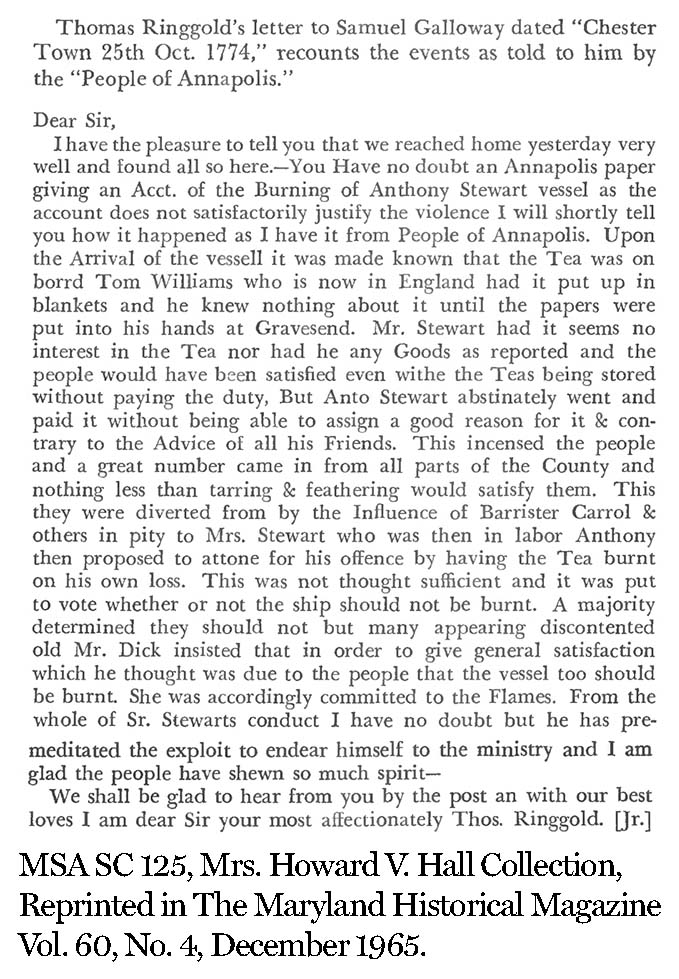 Peggy Stewart, losing a ship could cripple a merchant. This shows the pressure on
Stewart. Even with him destroying his own ship, some people were still not satisfied,
and an effigy of Stewart was burned in the streets. On October 19, 1774, Stewart and
several others rowed out into the harbor and scuttled the ship. Its remains sank into
the mud and today are believed to be under the fill that makes up the Naval Academy.
Many in Annapolis watched the events of that October, including Thomas Ringgold. He wrote to Samuel Galloway upon his return to Chestertown (original poor grammar and all):
“This incensed the people and a great number came in from all parts of the County and nothing less than tarring & Feathering would satisfy them. This they were diverted from by the Influence of Barrister Carrol & others in pity to Mrs. Stewart who was then in labor Anthony then proposed to attone for his offence by having the Tea burnt on his own loss. This was not thought sufficient and it was put to vote whether or not the ship should not be burnt. A majority determined they should not but many appearing discontented od Mr. Dick insisted that in order to give general satisfaction which he thought was due to the people that the vessel too should be burnt. She was accordingly committed to the Flames. From the whole of Sr. Stewarts conduct I have no doubt but he has premeditated the exploit to endear himself to the ministry and I am glad the people have shewn so much spirit.”
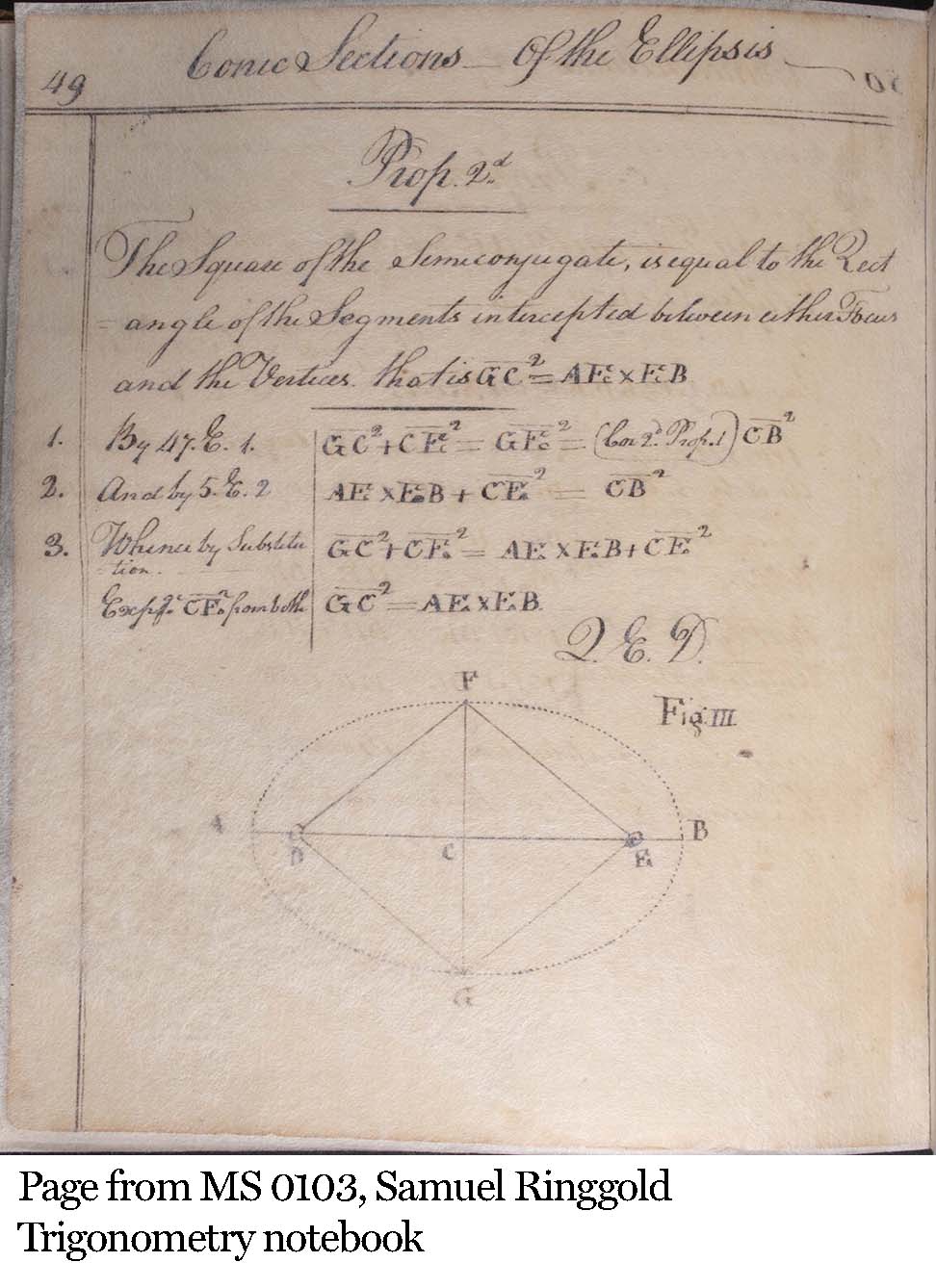
Thomas’ son Samuel was only four at the time of the events; he would later attend Washington College in its preparatory department, and we have an example of his coursework in trigonometry.
 Stewart and his family left America for Halifax, Nova Scotia. He spent years petitioning
the British government to recoup the losses of that day. You may well ask, what happened
to Thomas Williams, the man who started all this by trying to smuggle in tea? His
brothers bore the brunt of most of it as they were in Annapolis, but the news spread
through the colonies and hit New York the same time as Williams arrived there. It
was said he fled to Philadelphia and later signed a letter atoning for his deeds,
but as the war began, he fled. He, too, petitioned the British government for compensation.
The burning of the Peggy Stewart was a divisive act and showed the tensions and passions
of the colonies just before the American Revolution. Some viewed it with horror at
what we had become capable of; others saw it as a righteous act of rebellion and solidarity
against British oppression. Either way, it stands as a pivotal point in our history.