Piecing Together Mathematical Understanding
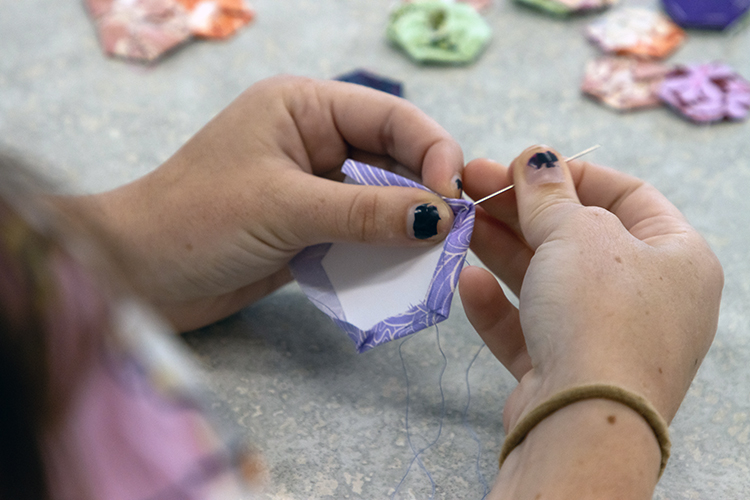
To prepare for professor Emerald Andrews's Math of Quilting course, Imogene Nuss '28 spent the summer as s Toll Research Fellow, learning about foundation paper pieceable quilts.
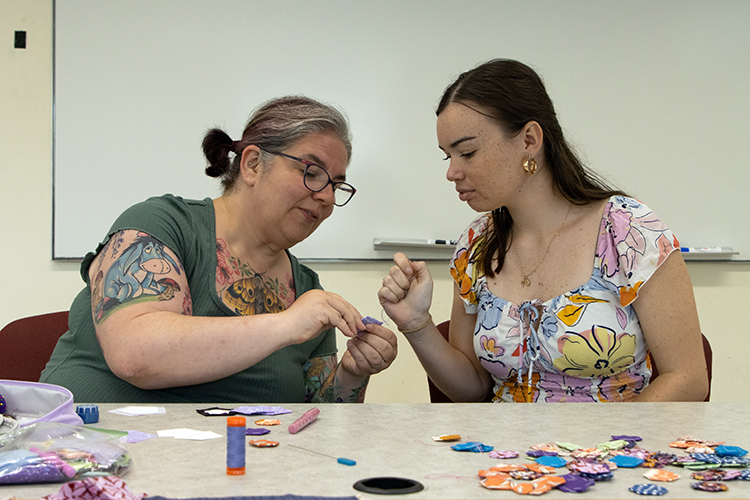
Math professor Emerald Andrews is once again teaching the Math of Quilting, an interdisciplinary course intended for non-math majors, providing them an option for their natural science and quantitative skills distribution requirements. The class is intended for students to learn math skills without having to take a traditional math course.
To prepare, Andrews hired Imogene Nuss ’28 as a John S. Toll Research fellow this summer.
“I was very interested in the actual math behind quilting. It had never occurred to me before,” Nuss said. “I think it’s really important, interdisciplinary study.”
She previously took another of Washington College’s interdisciplinary course offerings, Art in the Anthropocene, which combines studio art techniques with chemistry concepts and can be taken for credit in either the natural science or the fine arts and humanities division.
“It’s really important to see the world in so many different aspects—I learned that from Art in the Anthropocene,” Nuss said. “I think it’s important to come out of a liberal arts education with that understanding of what the world is like—that’s what sets you apart.”
While working with Andrews, Nuss’s assignment was to create a four-day unit lesson plan for the class based on an article in the academic journal ACM Transactions on Graphics: “A Mathematical Foundation for Foundation Paper Pieceable Quilts.” She spent the summer learning about paper pieceable quilts and working to translate those concepts into ones understandable to the students in the course.
Foundation paper piece quilting requires sewing pieces of fabric onto a piece of paper in a specific order, following the pattern sequentially. The paper proposes an algorithm to determine if something is paper piece feasible without going through the design and creation process just for it not to work.
“I could take all of these notes and make a semester-long class on this,” Nuss said. “It’s a big task to make these concepts accessible.”
In order to teach herself the paper, Nuss taught herself several other mathematical concepts too, including graph theory.
Nuss said there are many kinds of graphs, including directed and undirected ones. The ones she used most were tree graphs (“think like a family tree,” she said), which do not have cycles—options to travel more than one way between the graph’s points, or vertices. For paper pieceable quilts, Nuss said there should not be a cycle, and therefore only one, unique way to get from one vertex to another.
While vertices, the edges that connect them, cycles, and tree graphs provided essential groundwork for understanding the math of paper pieceable quilting, they aren’t the whole story. Hyper graphs model more complex situations because they can have more than one edge between two vertices and more than one vertex within an edge. These hyper graphs are a foundational theory for paper pieceable quilting.
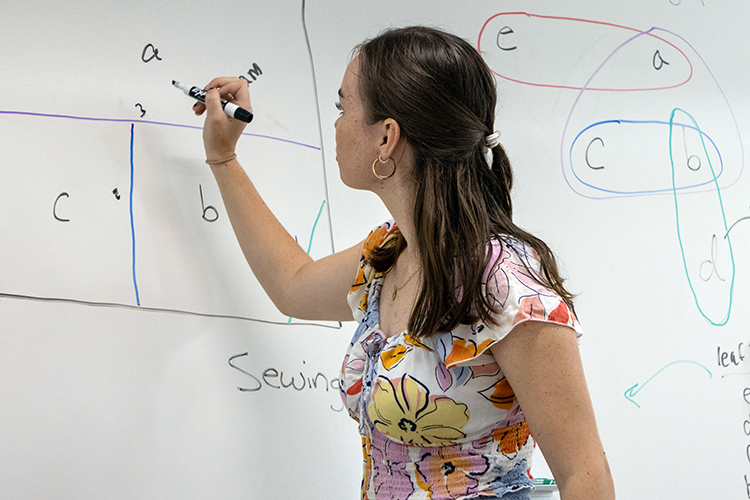
“It was a much bigger task than we thought,” Nuss said of teaching herself the paper.
Because of that, Nuss and Andrews applied for additional funding to continue their research into the fall semester, and Nuss will attend some of the Math of Quilting class sessions to assist students with aspects of the math and using the sewing machines.
“Dr. Andrews wanted me to lead myself and focus on and work on what was interesting to me,” Nuss said of the research. “The paper was a good place to start. It provided an analytical approach where I could be like, ‘OK I need to learn this and this to understand this paragraph,’ and it broke it down to something I could understand.”
Nuss got that approach from her professors, who advised her to break concepts down to the smallest unit she understands to make it accessible.
The research process was frustrating at times, Nuss said, because looking up terms she didn’t know often led her down entire rabbit holes, learning new theories.
“A lot of it is about being curious, playing with math and doing what you find interesting,” Nuss said. “I get stuck because there’s so much I can learn, but I think the experience of starting off with graph theory was really beneficial.
“It’s like how learning in general is taking one class before the next, especially in math. There’s something beneficial from having to experience learning it,” she added.
She said the experience of having a difficult subject and knowing the goal—to answer a question or finish working through a chapter—prevents it from becoming too overwhelming to start.
“It makes it easier to take on the harder aspects of this project because I have this foundation practicing doing problems and proofs where the answer is there, so now when I’m doing it and there’s no answer, it’s less scary,” she said.
Throughout the summer, Nuss and Andrews met to discuss Nuss’s progress through the paper and make sure she was correctly understanding the other mathematic theories she needed to do so. Sometimes these check-ins turned into small teaching sessions where Andrews talked Nuss through concepts. Sometimes they worked together to solve problems. Other times, they researched independently, then presented their findings. The two are continuing the mentoring model into their work this fall.
“It’s like having someone who understands what I’m explaining and can ask me important questions about it to make me keep thinking,” Nuss said of the collaborative process.
Nuss has been working through a textbook, watching YouTube videos, and completing practice problems throughout the summer to learn. She has made connections across topics and has seen how the paper brings these various theories together.
One of the most surprising discoveries for Nuss came not from the research, but she discovered within herself: that productivity can look different every day.
“I’ve been a sailing instructor—that’s eight hours exhausting in the sun. What was so shocking to me was how exhausted I was after three hours of talking about math. It’s crazy how exhausting using your brain is,” she said. Still, Nuss has pushed through, one day at a time, and worked through the research paper.
She also learned how to quilt. As the summer continued, she and Andrews spent part of their meeting times doing math, then worked on quilting techniques to prepare her for the various aspects of assisting in the class.
—MacKenzie Brady ’21