
Patently Rewarding Internship
Business major Cecilia Johnston ’27 gained database management experience at a museum sharing the history of American industry through an Explore America internship.
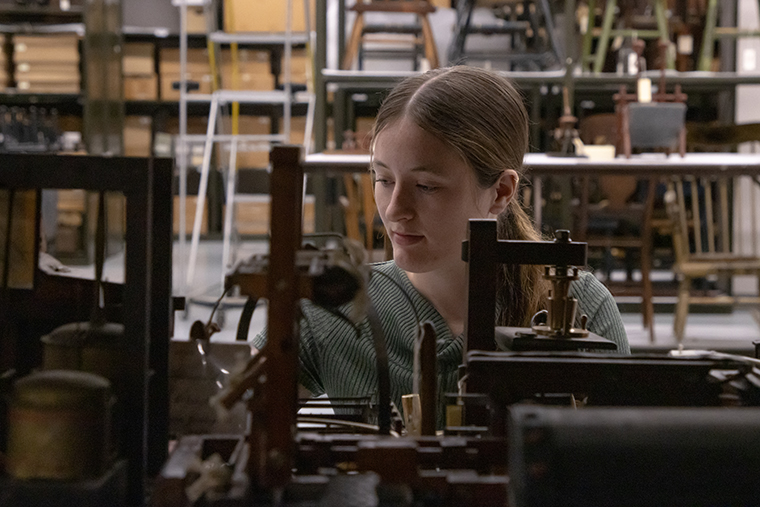
As a business management major with two minors—marketing and data analysis— Cecilia Johnston ’27 knew having database management experience would be a good career move. That was her primary goal when searching for a summer internship.
Johnston identified several interesting opportunities through the Explore America program from the Starr Center for the Study of the American Experience, which provides paid summer internships for dozens of Washington College students at prestigious cultural and other nonprofit organizations every year. Seeing that the Hagley Museum and Library needed an intern to work on the records in one of its collections’ databases, she applied.
Located on 235 acres just outside of Wilmington, Delaware, Hagley has taken Explore America interns for several years for several different kinds of work. On a former Dupont Company site, the museum and library share the history of business and innovation in the United States, showcasing working 19th-century technology used in gunpowder production, research collections including corporate records and papers from individuals, and the country’s second largest collection of patent models, which Hagley is continuing to catalog with help from Explore America interns.
In addition to a drawing and a description of an invention, the United States government required functioning models from anyone applying for a patent from 1790 to 1880. The models could be no more than 12 inches in any dimension and show not only new inventions, but also improvements to existing inventions that were substantial enough to require a new patent.
Johnston wasn’t sure what a patent model was when she applied to the Hagley internship, but as often happens with Explore America, she discovered an entirely new area of interest while building her resume and her skills for a career after graduation.
“I initially was not interested in history,” Johnston said. “I ended up loving it because working with the physical models themselves made it much more interesting. So this internship helped me get the hands-on experience with databases, figure out the things I like and want to pursue, and just widened my experience and my knowledge of the possible career opportunities.”
As a curatorial intern, Johnston became the latest in a decade of researchers who have been painstakingly unpacking, documenting, researching, and cataloging the Alan and Ann Rothschild Collection of 4,500 patent models, a donation the couple made in 2015 that vastly increased the museum’s holdings.
Hagley displays about 200 patent models between the museum and its library’s conference center, but adding the Rothschild collection to the 1,000 models it had previously means Hagley has far more models than it can display on site. The organization creates exhibits to be shown elsewhere when it loans pieces from its collection to other museums, libraries, and government buildings.
“The more we catalog, the more demand there is for us to do other things: write papers, speak, create exhibits,” said Chris Cascio, Hagley’s assistant curator for patent models and Johnston’s supervisor. “That is why having a Starr Center intern is so important. Cecilia is making groundbreaking discoveries. It’s a great fit.”
During her internship, Johnston took the vital first steps in a process that results in some models being restored and put on display, information being provided on Hagley’s online database, and patent models being made available to researchers of American ingenuity. Johnston’s job involved unpacking a box containing a model, locating its documentation by matching a patent number from a tag attached to the model, photographing it, researching the inventor online, and entering it all into Hagley’s internal database. But not every box Johnston unpacked this summer was straightforward.
Early on, she found a model with a tag that led her to a patent drawing and description that clearly did not match the physical object. With the first research step a dead end, Johnston had to take a different approach. Using her own description of the item, a partially legible name on the object, and plenty of time online, she uncovered the correct patent and ensured Hagley’s database connected the model to the right inventor and information. She wrote about the process for the Hagley blog in an article called “Mystery Machine: What is this Patent Model?”
But Cascio and Johnston both picked another of her research accomplishments as her most significant for the summer. When Johnston unpacked a model of a valve, it came with the correct patent number, and she quickly found that it had been invented by Joseph H. Lewis of Binghamton, New York. When she researched Lewis for Hagley’s records, Johnston matched names, addresses, and dates on census data and a 19th-century advertisement to establish that Lewis had most likely been Black, adding significance to the artifact. In the Hagley collection, only three patent models are known to have been created by Black inventors, and of 600,000 patents granted in the 1800s, less than 3% went to Black people. Johnston also wrote about her work on that item for the Hagley blog.
“Once that model goes through getting fixed up, it could go on display in other places like D.C.,” Johnston said. “It’s very cool to be a part of history and discovering these things.”
You can hear more of the interview with Cecilia Johnston about her internship with the Hagley Museum and Library in the latest episode of Unhurried Conversations, the Washington College podcast.
— Mark Jolly-Van Bodegraven