Pulitzer Prize-winning Poet Leads Student Workshop
Jericho Brown guided students in creating their own duplex poems, a form he invented.
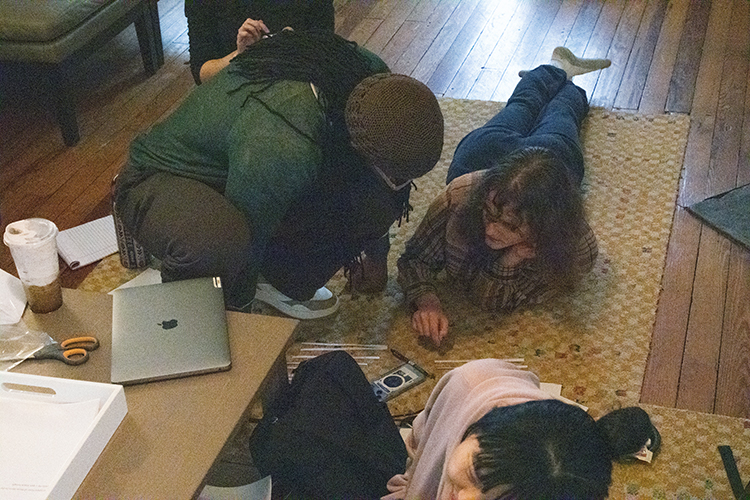
The Washington College Rose O'Neill Literary House transformed into a classroom space for a workshop with Jericho Brown as students spread throughout the enclosed porch, reader's room, and library to lay out individual lines on separate strips of paper and combine them in new ways to create their own poems.
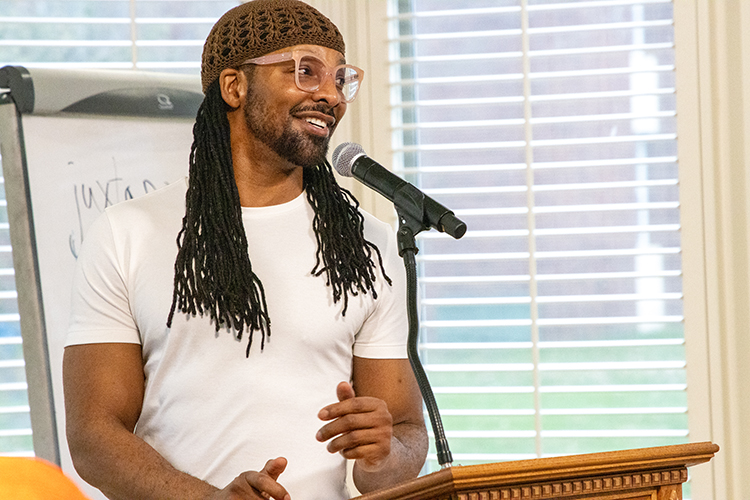
Brown, who won the 2020 Pulitzer Prize for Poetry for his book The Tradition, led a dozen attendees through the creation of their own duplex poem—a form of Brown's creation that debuted in that collection.
“The hallmark of the Literary House series is that the literary stars we bring for readings also are excited to engage meaningfully with our fabulous students,” said James Hall, director of the Lit House. “This tradition is robust and dates back to at least 1987, when Toni Morrison visited to read from the galleys of Beloved and met one-on-one with students about their own writing.”
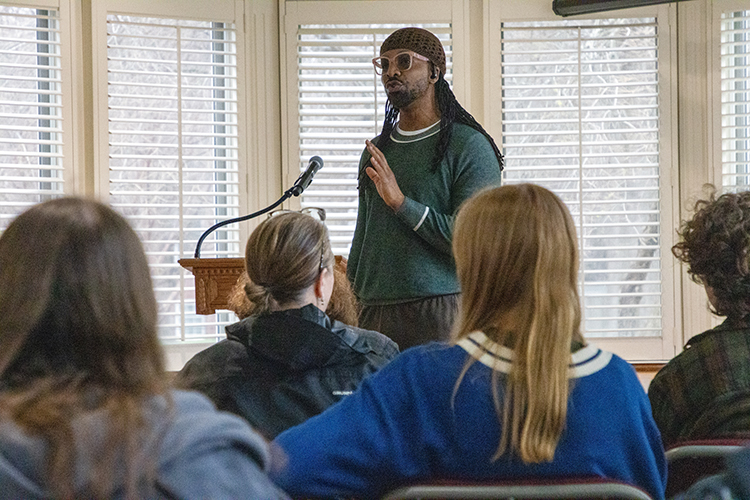 Seth Horan '26 attended the poetry workshop—despite most often writing prose himself—because
he has an interest in unique forms and wanted to see what he could take from the workshop
for his own writing.
Seth Horan '26 attended the poetry workshop—despite most often writing prose himself—because
he has an interest in unique forms and wanted to see what he could take from the workshop
for his own writing.
“I really enjoyed Jericho's presence—very engaging. This was one of the more engaging events I've been to,” Horan said.
To kick off the workshop, Brown talked about the creation of the duplex and the poetic history he pulled from to create the form. Attendees brought 14 of their own lines or sentences—each cut out on a separate piece of paper—containing nine to 11 syllables for the workshop. (Ahead of Brown's workshop, Hall hosted a smaller workshop with prompts so attendees would have lines ready for the main event.)
Brown said he made his first duplexes taking lines he'd written but never used, cutting them out on pieces of paper and rearranging them.
“I can now make a duplex without cutting up any paper, although I still make them on cut paper because cutting up paper puts you in a position where you can make different kinds of discoveries that you won't make if you're just trying to generate,” Brown said.
“I was interested in writing a poem that was all repetition,” he said of creating the duplex. “Is it possible to write a poem where the lines just keep repeating themselves? And what would that effect be?”
The duplex pulls from sonnets (14 lines with rules on meter), the blues (a poem with two repeating lines and then a third line that juxtaposes them, among other rules), and ghazals (a medieval Persian form that, among other rules, is made up of two line stanzas where the second line of every couplet features the same repeating word).
Brown spoke of the importance of juxtaposition in poetry generally, but also specifically the way it is deployed in the duplex, which he described as couplets that could each be their own poem, all in conversation with one another as a larger poem.
“When I think about juxtaposition, I think about putting two things together that have nothing to do with each other, but that become necessary to one another once you, the viewer, see them together,” he said.
Brown said that this juxtaposition encourages the reader to participate in the art itself as they try to determine what these juxtaposed lines have to do with one another, and what they mean for the poem as a whole.
“That's why these forms exist. They are asking after you, as a reader, for your participation. They're asking you to get involved with the choices that the poem makes in order to make the poem that exists,” he said.
After Brown read examples of his duplexes so attendees could better understand how they sound and how rhyme and repetition work in them, he led attendees through creating their own with the lines they brought.
First, attendees spread their lines out so they could see all of them at once. Then, Brown asked them to pick the “best” one—the strangest, most original, most unique, most inviting—that would make them want to read what comes after.
“Which one of those lines is a poem all by itself?” Brown asked them to consider.
Once that line was decided, they placed it to the side and chose another line that, as a couplet, made a poem.
“You might make that through narrative progression or you might make that from juxtaposition,” Brown said. “You didn't come here expecting those things to go together, you put them together, and we got something we did not expect.”
“You're not making a poem except for this couplet. That is the poem,” he added.
Next, participants wrote their couplet down, then removed the first line, slid the second line into the position of the first, and went back to the rest of their lines to find a new second one. This process was repeated until the last stanza.
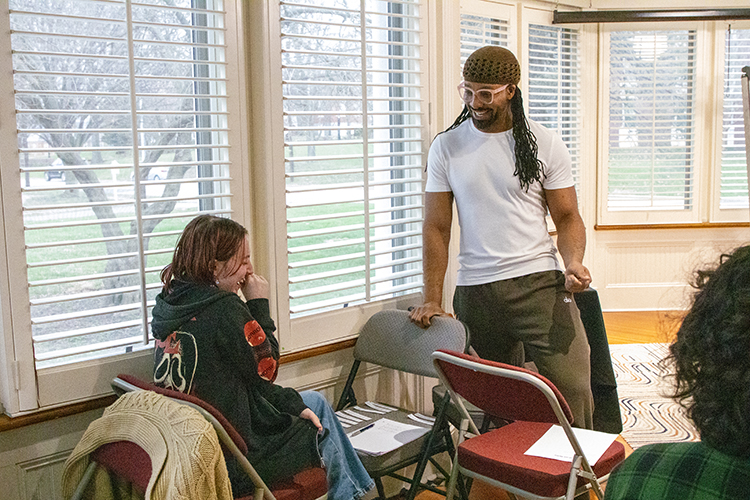
Attendees read their couplets aloud throughout the creation process. Brown would prompt them when it was time to start a new couplet. He walked throughout the space to look at students' couplets and see how they were pairing lines together.
“You only need to make one couplet that, on its own, will make the best couplet you can possibly make given the lines you've got,” Brown said. “Every time you make a couplet, it should be as if it's its own poem.”
“You have fewer things to choose from, which means you're being pushed in exactly the right direction,” he added.
The final couplet of the duplex is made by taking the last line from the sixth couplet and pairing it with the first line of the poem, so the first and last lines of the poem echo one another. Brown suggested looking at where some line edits could be made to create variation and slightly different content while still echoing the previous line—and sticking to the syllable count.
In the end, every attendee had written a duplex. Several of them read theirs aloud to the group.
“Today you wrote a duplex, which means you wrote a sonnet, which means you wrote a ghazal, which means you wrote a blues poem,” Brown said.
Brown encouraged attendees to write future lines when they think of them and keep them around—in the notes app of their phones, in a notebook—so that there are always lines to pull from to help generate future work.
“The workshop was rousing and fun, not just because Jericho is an excellent teacher, but also because of the communal feel of reading out lines and poetry and finding juxtaposition and tension that provided new ways of seeing our poems, and with a new way to approach writing and revising,” Hall said of the workshop.
Brown's visit to campus was part of the newly renamed Robert Earl Price Poetry Festival (formerly the Kent County Poetry Festival). Brown conducted workshops at both Washington College and Kent County High School on Friday, then read from and discussed his work Saturday night with Hall as the keynote event of the festival.
“Poetry was everywhere…when I was growing up, and I always went toward it. And wherever I would go where poetry was, there were other people there,” Brown said. “It seemed to me a fine idea and something I could indeed dedicate my life to because it did so much work in my heart and so much work to me. Reading poems, I learned a lot about science, I learned a lot about love.”
— MacKenzie Brady '21