Finalists to Appear in Conversation at Mount Vernon on August 20.
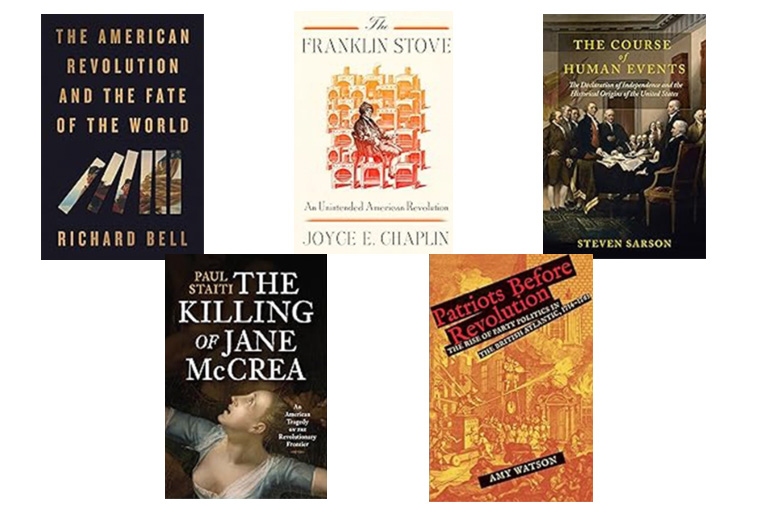
Five books published in 2025 and written by some of the nation’s most renowned historians
are finalists for the 2026 George Washington Prize. This annual award celebrates the
year’s best works on the founding of our nation, particularly those that broaden public
knowledge of early American history.
The $50,000 George Washington Prize, created by George Washington’s Mount Vernon, the Gilder Lehrman Institute of American
History, and Washington College, is one of the nation’s largest and most notable literary
awards.
The 2026 George Washington Prize finalists are (in alphabetical order):
- Richard Bell, The American Revolution and the Fate of the World (Riverhead Books, 2025)
- Joyce Chaplin, The Franklin Stove: An Unintended American Revolution (Farrar, Straus and Giroux, 2025)
- Steven Sarson, The Course of Human Events: The Declaration of Independence and the Historical Origins
of the United States (University of Virginia Press, 2025)
- Paul Staiti, The Killing of Jane McCrea: An American Tragedy on the Revolutionary Frontier (Westholme Publishing, 2025)
- Amy Watson, Patriots Before Revolution: The Rise of Party Politics in the British Atlantic, 1714-1763 (Yale University Press, 2025)
Adam Goodheart, Hodson Trust-Griswold Director of the
Starr Center for the Study of the American Experience at Washington College, said, “In this landmark anniversary year of our nation’s founding, both scholars
and readers are paying renewed attention to the meaning and memory of the Revolution.
The 2026 finalists demonstrate that new light is being shed on the old stories, and
that the global reverberations of 1776 continue to echo today.”
Lindsay Chervinksy, Executive Director of the George Washington Presidential Library,
said, “We are so thrilled to share finalists that highlight the breadth and depth
of the American Revolution, in the United States and around the globe. They offer
something for every reader excited by the nation's 250th anniversary to learn more
about the country's founding story.”
James Basker, President and CEO of the Gilder Lehrman Institute of American History,
said, “The ideals and events of the American founding are still reverberating 250
years later, as these excellent books show. New stories, new insights, and a renewed
sense of why history matters more than ever!”
Each year since the Prize was created in 2005, an independent jury has evaluated 50
to 100 books published in the previous year that explore the history of the American
founding era. The five books named finalists for the 2026 Prize are outstanding examples
of robust and thought-provoking explorations of America’s unique history.
The finalists will discuss their books at an event at George Washington’s Mount Vernon
on Thursday, August 20, 2026. The authors will be available for book signings immediately
following the conversation.
The George Washington Prize winner will be announced at a gala dinner in New York
City on October 5, 2026.
Additional Information
Richard Bell, The American Revolution and the Fate of the World
Richard Bell, a British-born historian, restores the American Revolution to the vast
imperial worlds in which it was born, waged, and won. In his hands, the War for American
Independence becomes a sweeping struggle over commerce, boundaries, sovereignty, slavery,
and the very meaning of liberty itself. Moving from familiar locales like Boston and
Philadelphia across the Atlantic and as far afield as India and Australia, Bell shows
how a rebellion in thirteen minor British colonies in America remade lives and reordered
empires across the globe. He is especially good at recovering the voices of those
pushed to the margins of patriotic narratives, from Molly Brant and Harry Washington
to privateers, convicts, common soldiers, and loyalist refugees. Accessibly written
and exhaustively researched, The American Revolution and the Fate of the World is
a timely reminder that America’s story has never unfolded in isolation.
Joyce Chaplin, The Franklin Stove: An Unintended American Revolution
Sparkling, witty, compelling—not the usual adjectives applied to a deeply researched
historical study. But in the hands of a master historian, the humble Franklin stove
provides the starting point for wide-ranging and inventive (pun intended) discussions
of technology, colonialism, science, and the environment. Along the way, Joyce Chaplin
also offers a fresh take on Benjamin Franklin, as scientist and entrepreneur. Chaplin
especially shines when she links the historical past to the urgencies of the present.
Anyone who thinks our environmental problems and possible solutions are new to America
will be struck by the similarities between then and now.
Steven Sarson, The Course of Human Events: The Declaration of Independence and the Historical Origins
of the United States
With this timely book, Steven Sarson reminds readers that the authors and signers
of the Declaration of Independence operated . . . well . . . in the course of human
events. That is, they molded the Declaration within a long context of historical events.
Rather than a rupture with history, the Declaration encapsulated long-held understandings
of natural law, which Sarson argues lay at the heart of the document. As Americans
commemorate America250, Sarson demonstrates that they have much to celebrate in the
revolutionary aspirational creeds of the Declaration even as they confront a document
wedded to the past as much as to the future.
Paul Staiti, The Killing of Jane McCrea: An American Tragedy on the American Frontier
There was a time when everyone in the British Atlantic world knew (or thought they
knew) the tragic story of Jane McCrea. Acclaimed art historian Paul Staiti centers
this long-forgotten tale around an arresting 1804 painting in order to dive deeply
into issues of Native Americans, the war of independence from both sides, and the
use of women in propaganda. With the expertise and zest of an accomplished storyteller,
Staiti uses visual images, commentaries, personal papers, and literature to both show
the ubiquity of the incident and demonstrate the multiple meanings for people of the
time. Ultimately, the Native Americans must also be counted as victims of this tragic
tale as it became a rationale for discrimination and violence.
Amy Watson, Patriots Before the Revolution: The Rise of Party Politics in the British Atlantic,
1714−1763
In this eye-opening reconstruction of eighteenth-century British politics, Amy Watson
reveals an American Revolution that was, with thorough irony, very British. She exposes
a British Empire rife with political dissent and instability before 1763, providing
critical insight into the historical context of American revolutionaries. Rather than
invent new theories about British constitutionalism, those revolutionaries drew on
decades of arguments about the proper limits and purposes of Parliament’s power. They
also borrowed means of protesting what they considered Parliamentary overreach. Around
the British Empire—in London, Edinburgh, New York, and Georgia—British subjects contested
Parliamentary powers with oppositional politics that future American revolutionaries
adopted.
