William Carmichael: Local Boy, Revolutionary Diplomat… and Spy?
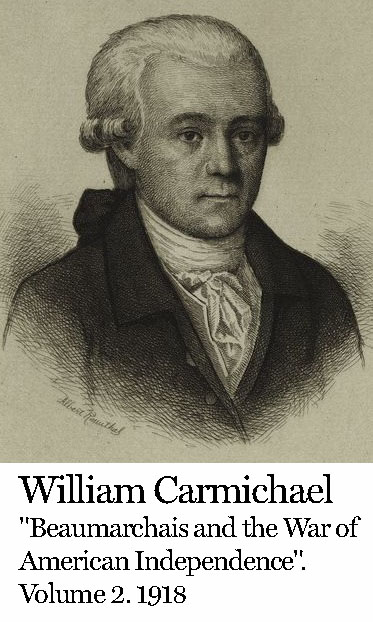
Born just across the Chester River from Chestertown at the family home, Round Top, William would lead a life of intrigue far from the Eastern Shore.
Like many men of wealth in Colonial America, he was sent to England for his education. William attended the University of Edinburgh. He returned to the Eastern Shore by 1774, where he joined the Committee of Correspondence. As tensions began to rise in the Colonies, various groups began to form; most notably were the Sons of Liberty, but as more and more were created, Samuel Adams established a committee that would communicate through an underground network of letters. Starting in Boston in 1772, it expanded South to Virginia by 1773, and by 1774 all of the thirteen colonies had an active committee. This committee was extremely important not only in connecting thirteen disparate colonies but also in paving the way for the First Continental Congress. Carmichael was also supposedly in Chestertown for its own “Tea Party” and attack on the brigantine Geddes.
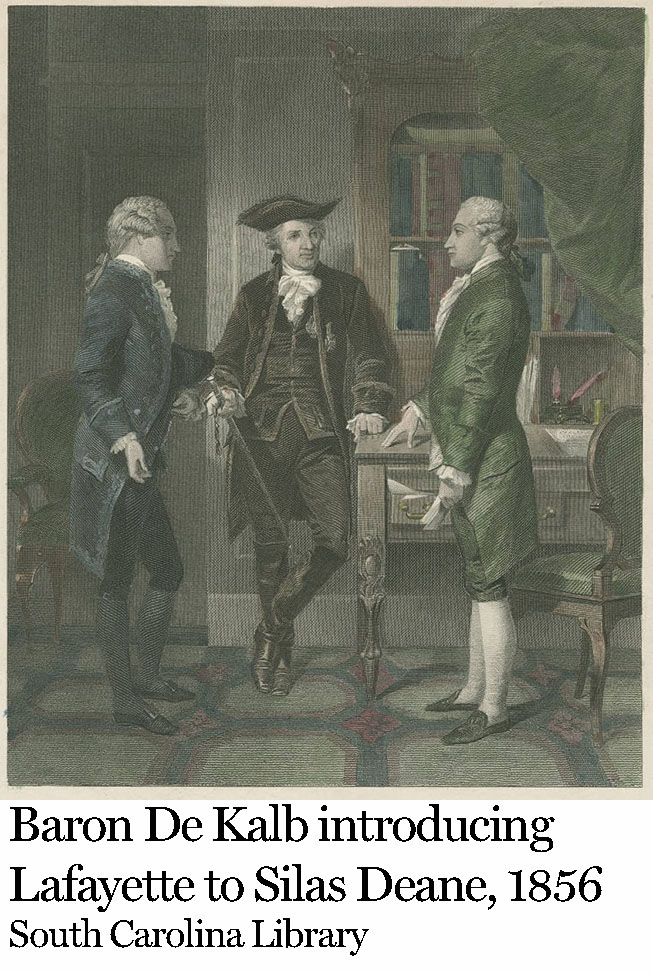 When the Revolution began, Carmichael went to Europe, reportedly with letters from
the Congress hidden among his possessions. His European education had given him numerous
contacts throughout the region, and he went to France to work with Benjamin Franklin
and Silas Deane. While Franklin served as Ambassador to France, Deane and Carmichael
acted under the guise of commercial agents. This enabled them to purchase goods for
the colonies, including armaments from French businessman Pierre-Augustin Caron de
Beaumarchais. The cover also allowed them to travel throughout Europe, making contact
with foreign military leaders, including the Marquis de Lafayette and Casimir Pulaski,
heroes of the Revolution. Carmichael was sent to Berlin to court Frederick II of Prussia.
William returned to America by early 1778.
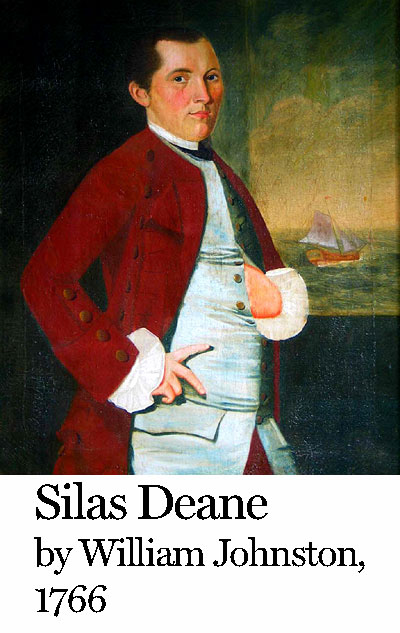 The Americans working in secret in France were also joined by Arthur Lee, who did
not get along with Deane and accused him of fiscal irregularities. Deane had also
begun to lose the favor of the Continental Congress and was recalled back to America.
The French government wouldn’t supply evidence about the financial deals, which would
have blown the “secret” part of the secret mission, so Deane went back to France to
try to clear his name. While away in 1781, the British had intercepted letters in
which Deane questioned the Revolution; a newspaper published them, further tarnishing
his reputation. Deane was banned from returning to America. He was stranded in Europe
until 1789. When he was ready to make his way home, he was found dead on a docked
ship. A mysterious death for a spy.
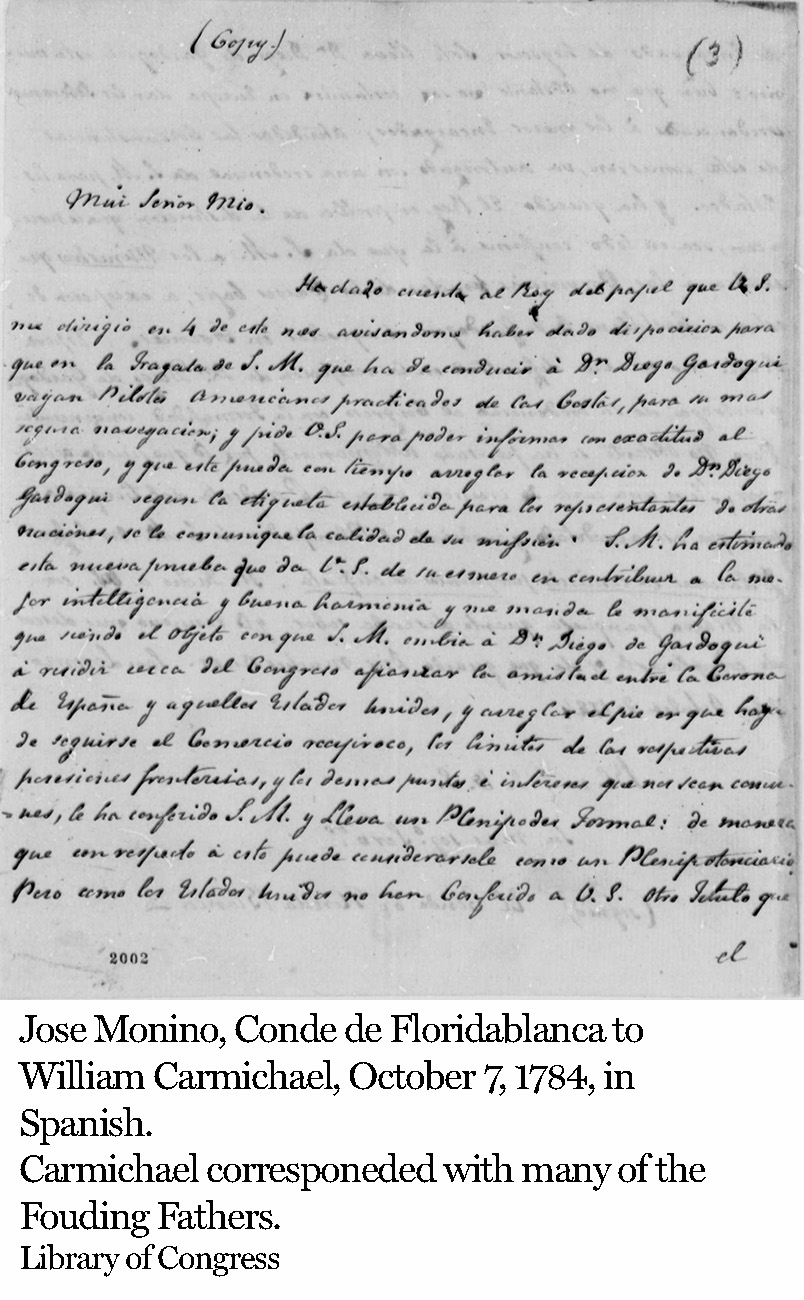 After briefly serving on the Continental Congress, William Carmichael went on to work
with John Jay as Chargé d’Affaires, or diplomat, stationed in Spain. He played a vital
role in securing financial aid for the Revolution as well as naval intelligence. He
laid the foundation for the Treaty of San Lorenzo, also known as Pinckney’s Treaty.
Carmichael died before the treaty was concluded on October 27, 1795. The treaty resolved
territorial disputes along the Mississippi River and allowed duty-free transport through,
then, Spanish-controlled New Orleans. Carmichael also negotiated the release of American
mariners held captive in Algiers, though this would not stop the future Barbary War.
He worked for the cause for over a decade; he married a Spanish woman, Antonia Reynon, and together they had a daughter, Alphonsa Carmichael Blake. While in Spain, Carmichael had difficulty receiving his compensation from the Continental Congress, using up his own fortune in the process. He died in Spain on February 9, 1795, and was buried in the Protestant cemetery. His wife and daughter returned to the Eastern Shore and continued to petition the United States government for the money owed to William; they were eventually successful.
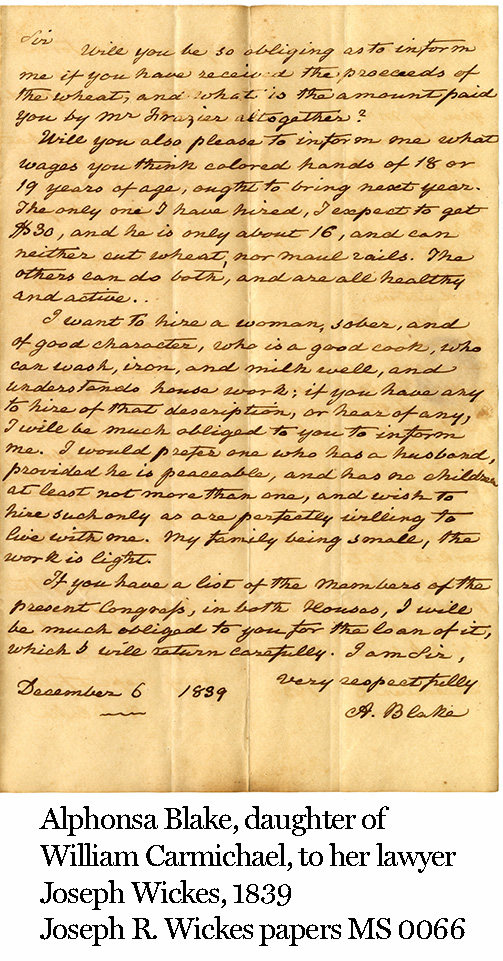 Alphonsa married Kent County native James Blake. The College’s archives have several
documents related to Alphonsa and others in the Carmichael extended family. Alphonsa
Blake had dealings with local lawyer Joseph Wickes, including several letters regarding
one of the enslaved individuals she owned, Charles. Like many slave owners on the
Eastern Shore, Alphonsa hired out her enslaved workers to other farms. Through the
course of the letters, we see Charles’ saga: first accused of theft, then shuffled
off to Baltimore, and eventually Alphonsa asking about selling him. You can read these
letters on the Chesapeake Heartland Digital Archive.