
Hogan Institute Names Inaugural Executive Director and Faculty Director
U.S. Army veteran Colin Pascal and political science department chair Christine Wade will lead new nonpartisan initiative launching programming this fall, with former Lt. Gov. Boyd Rutherford and a distinguished Advisory Board guiding its work
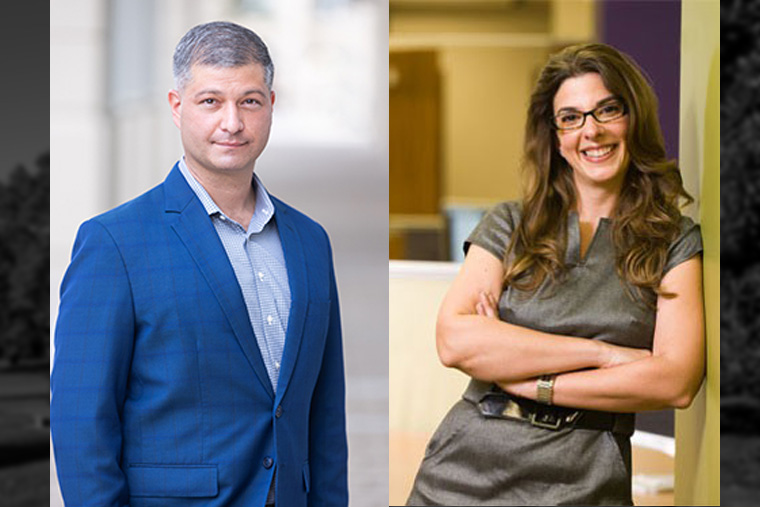
The Hogan Institute today announced the appointment of Colin Pascal as its inaugural executive director and political science department chair Christine Wade as the first faculty director. Mr. Pascal and Dr. Wade will join a distinguished Advisory Board drawn from government, business, nonprofit, and academic life to steer the Institute, which was announced by former Maryland Governor Larry Hogan during his speech at the 243rd commencement at Washington College.
The appointment marks a significant step as the Institute prepares to launch programming later this fall, where students will engage directly with leaders and practitioners from across all levels of government to gain a clearer understanding of how governing works and how it can work better through workshops, seminars, and public forums.
Pascal will work with a distinguished Advisory Board that includes former Maryland Lt. Gov. Boyd Rutherford, Governor Hogan’s two-term governing partner.
“We are at an inflection point in American public life—a moment that demands leaders who put principle before politics and country before self,” said Governor Hogan. “The Hogan Institute exists to develop exactly those leaders. Colin Pascal’s commitment to service and leadership, together with the collective wisdom of our Advisory Board, gives the Institute a strong foundation. Together, they will help build its mission and carry it forward for Washington College students and the broader community.”
Pascal brings to the role a decorated 20-year career as a U.S. Army Military Intelligence officer and a record of national-security leadership. A retired lieutenant colonel, he spent 52 months assigned in Iraq and Afghanistan, serving as an assistant Army attaché at the U.S. Embassy in Baghdad and as director of human intelligence and counterintelligence for Operation Inherent Resolve. He previously served as director of operations for the U.S. Army Foreign Counterintelligence Activity, overseeing sensitive counterintelligence operations worldwide. Pascal is a graduate of multiple specialized intelligence and counterintelligence qualification programs. He holds a bachelor’s degree in history from St. Bonaventure University and a master’s degree in military art and science from the U.S. Army Command and General Staff College, and a Master of Public Administration from American University.
Working hand in hand with Pascal will be faculty director Dr. Christine Wade, the Louis L. Goldstein Chair in Public Affairs and chair of Washington College's political science department. Wade is a prominent U.S scholar of Central American politics and has spent her career studying political violence, peacebuilding, democracy, authoritarianism, and human rights. She is the author of several major works on regional politics and has returned to the region regularly for more than three decades to conduct field research. For 15 years Wade has directed programming for the Goldstein Program in Public Affairs, managing a speaker’s series and sponsoring student opportunities for experiential learning. Wade will help to ensure the Institute’s programming is fully integrated into the academic experience of Washington College.
The Hogan Institute at Washington College is a nonpartisan initiative dedicated to
leadership rooted in character, respect for institutions, and the discipline to work
across differences in pursuit of the common good. Its work complements Washington
College’s historic liberal arts mission of preparing citizen leaders through critical
thinking, effective communication, and moral courage.
Drawing on Governor Hogan’s record of bipartisan governance, the Institute will explore
how pragmatic, results-oriented leadership can still deliver meaningful outcomes for
citizens. That example—and the values behind it—will shape the Institute’s approach
to leadership development, public service, and civic engagement.