
Alumna, Students Gain Campaign Experience
Washington College’s focus on connecting students to opportunities that put their classroom learning to work in the real world is helping three Shorewomen participate in the political process this election year.
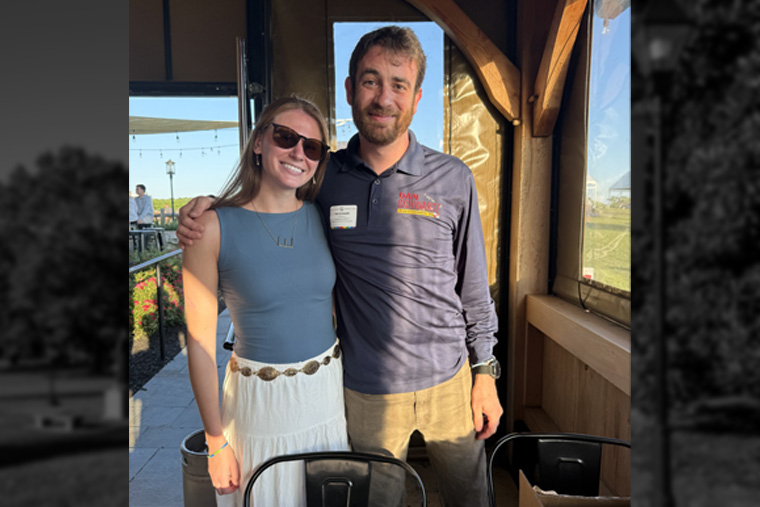
Emily Iampieri '25 and Congressional candidate Dan Schwartz
In politics, it’s all about who you know. For Emily Iampieri ’25, tapping into political
science professor Flavio Hickel’s network landed her a dream opportunity: working
for a political campaign.
Iampieri, who graduated with a degree in political science, came to Washington College
planning to attend law school and one day run for office. Her plans changed after
taking a foundational course for law school and not enjoying the content. That same
semester, she took Hickel’s course on campaigning and elections and realized that
was where her career trajectory was headed.
For the last year, Iampieri has worked on the campaign of Dan Schwartz for Congress,
a Democratic newcomer challenging long-time incumbent Andy Harris for Maryland’s first
congressional district.
What started as volunteering has turned into a full-time position as a political organizer
for the northern part of the district, overseeing operations for Cecil, Harford, and
Baltimore counties—the part of the district Iampieri calls home.
“Being from here, I have more knowledge of the geography, what areas we want to be
doing field operations,” Iampieri said.
As a political organizer, Iampieri coordinates and trains volunteers, organizes events
like phone banking, canvasing, meet and greets, and a watch party for election night.
As the election looms closer, Iampieri’s attentions have turned more toward phone
banking and canvasing. “That’s how we’re going to convince people to vote.”
“Fifty-three percent of the vote is in my region, and a lot of that is Harford County,”
Iampieri said. “Obviously no one county is more important than another county, but
a lot of the vote is here, so [my] focus is ‘where haven’t we knocked.’”
Iampieri said one of her favorite aspects of campaigning is talking with people. While
people don’t always answer the phone for numbers they don’t know or answer the door,
especially if they have a camera and can see who is there, the conversations have
been “overwhelmingly positive,” she said.
While Schwartz is running as a Democrat, Iampieri said the campaign is making an effort
to reach residents across District 1, regardless of party affiliation.
“This is a Republican-heavy district. We can’t just talk to Democrats, we have to
talk to Independents, we have to talk to Republicans,” she said. “It’s always good
to remember that even if we disagree politically, people aren’t inherently mean and
rude.”
As the campaign has progressed, Iampieri has used her newfound network to help former
classmates get involved. When the campaign started hiring fellows, she immediately
had two people in mind, who she encouraged to apply.
Reagan Klein ’27 was hired as a campaign fellow initially before becoming the political
organizer for Kent and Queen Anne’s counties. Sofia Garcia ’28 was also hired as a
fellow, now working under Klein.
Klein, an international studies and French studies double major, has known since high
school that she was interested in international relations. After graduation, she hopes
to go to graduate school to study national security. She has worked on several political
campaigns, most in her home state of Connecticut, where she has seen the behind-the-scenes
work of information collection and how that influences public policy.
“That’s what I’ve liked working on campaigns, getting to see that people-first process
and interacting with [people] to know how these daily issues affect them, then taking
that to the behind-the-scenes. It keeps you informed and keeps you more levelheaded
on intelligence and strategic goals,” Klein said.
Like Iampieri, Klein’s role has her in charge of field operations, including volunteer
outreach, engaging with the voter base, organizing canvasing and phone banking events,
and maintaining contact with local organizations, tapping into their resources.
“I love talking to people and hearing what they have to say,” she said of her work.
“People are going to appreciate that you have people out there, that’s one of the
good things about door knocking—it’s a sign of respect, showing that you care.
“Individual people matter, no matter where you fall on the political spectrum,” Klein
said, adding that many people talk about their experiences and how legislation has
affected their jobs or family.
A seasoned veteran of campaigning, Klein said that it’s a great way for anybody—regardless
of major or age—to get involved.
“It’s a really good research opportunity. You don’t go into it with a research question,
but it can answer a lot of questions that are probably coming up in your classes,”
she said, adding that she’s currently learning about identity theory in a religion
and politics class and sees it play out in real world cases during the campaign.
For Garcia, the campaign provides her first hands-on learning opportunity for her
political science major after several teaching experiences for education studies.
She helps Klein with her duties, phone banking, canvassing, and completing administrative
volunteer coordination and training.
“It takes so much more work than I thought. You need so many people, volunteers,”
Garcia said of running a campaign. “There’s layers I didn’t expect. … Every person
in the campaign is really crucial.”
Garcia has enjoyed getting to know people throughout her time as a fellow but was
surprised at how few people her own age were involved.
“The young people are not in it, which is really sad and surprising because all these
things that are happening are going to affect us,” she said. “Some people say ‘I don’t
do politics,’ but politics don’t care if you do don’t them, they’re still going to
happen.”
Despite low participation from young folks, Garcia said that working on the campaign
has shown her that “people do care about other people and want change.”
“It doesn’t matter how you’re politically affiliated … just vote,” Klein said. “Vote
like it’s your right to do. It’s so important.”
Regardless of the results of the election—Tuesday, Nov. 3—Iampieri, Klein, and Garcia
all said they would work on another campaign.
And while in politics the end of a campaign means the end of one’s current job, Iampieri
is confident that, with the new connections she’s made through the campaign, she will
find her next role soon.
—MacKenzie Brady ‘21